Analytic Number Theory and its Interfaces
Mathematics

Tim Browning
Professor
1 Career
- Since 2018 Professor, Institute of Science and Technology Austria (ISTA)
- 2012 – 2018 Professor, University of Bristol, UK
- 2008 – 2012 Reader, University of Bristol, UK
- 2005 – 2008 Lecturer, University of Bristol, UK
- 2002 – 2005 Postdoctoral Research Fellow, University of Oxford, UK
- 2001 – 2002 Postdoctoral Research Fellow, UniversitÉ de Paris-Sud, Orsay, France
- 2002 PhD, Magdalen College, University of Oxford, UK
1.1 Selected Distinctions
- 2025 Plenary lecture, ÖMG-DMV annual meeting, Linz, Austria
- 2023 Plenary lecture, British Mathematics Colloquium, Bath, UK
- 2022 Member of Academia Europaea
- 2022 Editor for Compositio Mathematica
- 2021 Ferran Sunyer i Balaguer Prize
1.2 Selected Grants
- 2022 – 2025 FWF (stand-alone projects), Rational curves via function field analytic number theory, Awarded overall: € 360,748.
- 2019 – 2022 FWF (stand-alone projects), New frontiers of the Manin conjecture, Awarded overall: € 356,799.
- 2017 – 2020 EPSRC (Standard Grant), Between rational and integral points, Awarded overall: £ 357,561.
1.3 Tech Transfer (Patents, Spin-Offs)
N/A
1.4 Selected Publications
- Tim Browning and Will Sawin, A geometric version of the circle method. Annals of Math. 191 (2020), 893–948.
- Tim Browning and Roger Heath-Brown, Density of rational points on a quadric bundle in . Duke Math. J. 169 (2020), 3099–3165.
- Tim Browning, Cubic forms and the circle method. Progress in Math. 343, Birkhäuser, 2021, 166 pages.
- Tim Browning, Pierre Le Boudec and Will Sawin, The Hasse principle for random Fano hypersurfaces. Annals of Math. 197 (2023), 1115–1203.
- Tim Browning and Florian Wilsch, Integral points on cubic surfaces: heuristics and numerics. Selecta Math. 31, Paper No. 81, (2025).
2 Group Members
- Yijie Diao, PhD Student since 2022
- Lena Wurzinger, PhD Student since 2023
- Anna Zanoli, PhD Student since 2023
- Christian Bernert, Postdoc since 2025
- Matteo Verzobio, Postdoc since 2023
3 Research
Mathematics is undeniably the universal language of science and nature, whose processes are often
governed by equations. The research of the analytic number theory and its interfaces group focuses
on systems of equations involving polynomials with integer coefficients. The study of rational or
integral solutions to Diophantine equations is a subject that is both ancient and difficult, having
commanded our attention since the time of the ancient Greeks nearly 2000 years ago. It has had
profound interactions with a host of subject areas, ranging from algebraic geometry to complex
analysis via mathematical logic and everything in between. There are two fundamental questions
that drive the group’s research: Can we decide the existence of rational or integer solutions? Can
we describe their frequency in some way? Passing to the language of arithmetic geometry, given
a number field k and a projective algebraic variety defined over , the desire to understand the
set () of -rational points on is both natural and challenging to satisfy. The group’s research
has been at the vanguard of marrying analytic and algebro-geometric methods to drive forward our
understanding of the set () for appropriate families of varieties .
3.1 Current Scientific Projects/Directions
- Moduli spaces of rational curves
- Rational points on Fano varieties
- Arithmetic statistics
- Manin conjecture
- Circle method
3.2 Scientific Highlight
Questions about the integer zeros of cubic Diophantine equations have long been a focus of research.
When defines an irreducible cubic surface , this presents a formidable challenge, where even knowing what to expect can often appear out of reach. In an extensive recent
investigation with a former ISTA postdoc, we developed a new heuristic for the behaviour of the
counting function , which is defined to be the number of (x, y, z)
such that (x, y, z) = 0. A famous example is given by the cubic polynomial = x3 + y3 + z3 − , for non-zero . A folklore conjecture states that there should be integer solutions if and only if
mod 9. In 2021, when = 42, Booker–Sutherland discovered the solution
42 = 804357581458175153 + (−80538738812075974)3 + 126021232973356313,
which is still the only known integer point on this particular surface, though we expect that
. For an arbitrary cubic surface = 0, our heuristic predicts that
should behave like , where is the rank of the Picard group Pic() and b is a
constant related to the divisor at infinity over . In very special situations the presence of a large
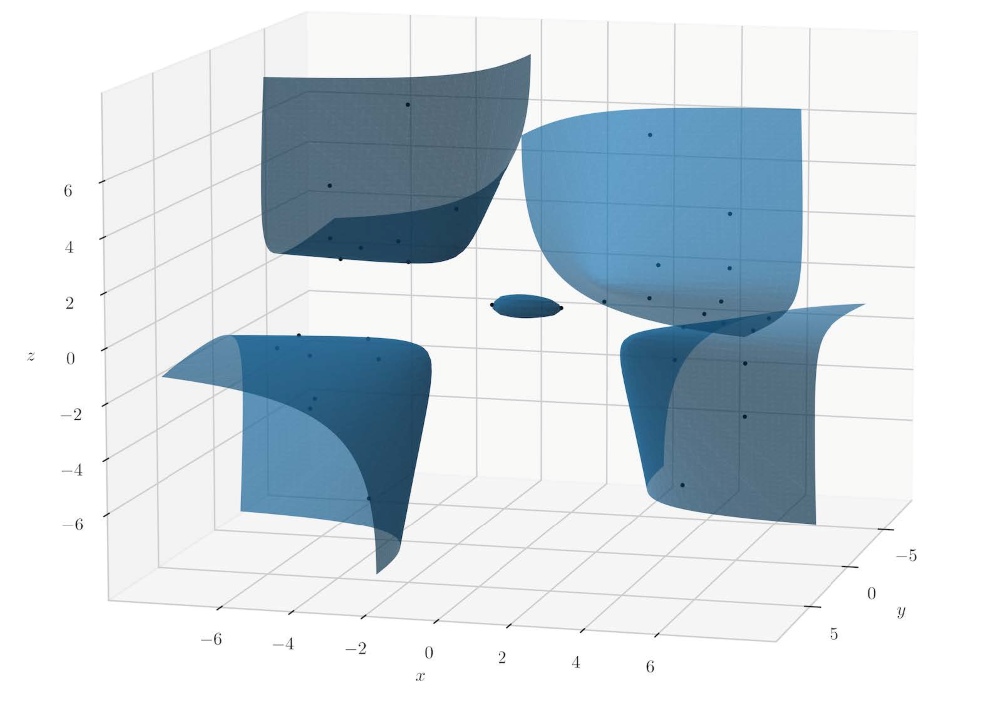
automorphism group actually allows one to estimate . For example, in Figure 1 is a cubic
surface with 5 connected components for which it is possible to prove ∼ 5.22(log )2, and
which agrees with the heuristic, since in this example. Our heuristic uses an adelic
version of the smooth δ-method variant of the circle method. Note that the surface is
K3 if its compactification is smooth and has strict normal crossings, placing it beyond
the usual Fano regime, which is where the circle method is most commonly applied. This work was
published in 2025: T. Browning and F. Wilsch, Selecta Mathematica 31, Paper No. 81 (2025).