
Quantum Integrated Devices
Physics
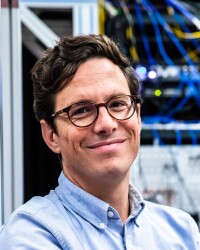
Johannes Fink
Professor
1 Career
- Since 2021 Professor, Institute of Science and Technology Austria (ISTA)
- 2016 – 2021 Assistant Professor, Institute of Science and Technology Austria (ISTA)
- 2016 – 2017 Visiting Associate Faculty, California Institute of Technology, USA
- 2015 – 2016 Senior Staff Scientist, California Institute of Technology, USA
- 2012 – 2015 IQIM Postdoc, California Institute of Technology, USA
- 2011 – 2012 Postdoc, ETH Zurich, Switzerland
- 2006 – 2010 Research Associate and Teaching Assistant, ETH Zurich, Switzerland
1.1 Selected Distinctions
- 2024 Invited talk at the Nobel symposium NS194 ‘Quantum control of mechanical systems: from fundamental research to technological applications’, Göteborg, Sweden
- 2023 – 2026 Elected member of the ISTA professorial committee
- 2023 Review committee member for the 2023 Research Assessment of the four Applied Physics Departments at TU Delft
- Since 2022 Board member of the FWF cluster of excellence quantA
- 2018, 2023, 2024, 2025, 2026 Invited talks at the APS March Meeting/Global Physics Summit
- 2018 Fritz Kohlrausch prize of the Austrian Physical Society
1.2 Selected Grants
- 2025 – 2028 Coordinator of Horizon Europe Pathfinder CIELO (101187231): Breaking barriers in quantum technologies with electro-optic interconnects. Co-investigators: Kippenberg (EPFL), Koos (KIT), Steele (Delft), Seidler (IBM), Mertens (SILORIX), Bereyhi (LUXTELLIGENCE), EU contribution overall: € 2,548,532.50, awarded to RG: € 766,000.
- 2023 – 2028 ERC Consolidator Grant 2022, cQEO: Cavity Quantum Electro Optics – Microwave photonics with nonclassical states, € 1,999,000.
- 2018 – 2023 ERC Starting Grant 2017, QUNNECT: A Fiber Optic Transceiver for Superconducting Qubits, € 1,500,000.
1.3 Tech Transfer (Patents, Spin-Offs)
- 2025 Qubit Device, Johannes Fink and Martin Zemlicka, European patent: EP23219355.7
- 2024 Techniques for bidirectional transduction of quantum level signals between optical and microwave frequencies using a common acoustic intermediary, Oskar Painter, et al. US Patent 10,858,240
- 2024 Techniques for transduction and storage of quantum level signals, Oskar Painter, et al. US Patent 10,858,239
1.4 Selected Publications
- All-optical superconducting qubit readout
G. Arnold*, T. Werner*, R. Sahu, L. N. Kapoor, L. Qiu, J. M. Fink
Nature Physics 21, 393–400 (2025) DOI - Inductively shunted transmon: A superconducting qubit with flux noise insensitive plasmon states and a protected fluxon decay exceeding 3 hours
F. Hassani, M. Peruzzo, L. N. Kapoor, A. Trioni, M. Zemlicka, J. M. Fink
Nature Communications 14, 3968 (2023) DOI - Entangling microwaves with light
R. Sahu*, L. Qiu*, W. Hease, G. Arnold, Y. Minoguchi, P. Rabl, J. M. Fink
Science 380, 718 (2023) DOI - Converting microwave and telecom photons with a silicon photonic nanomechanical interface
G. Arnold*, M. Wulf*, S. Barzanjeh, E. S. Redchenko, A. Rueda, W. J. Hease, F. Hassani, J. M. Fink.
Nature Communications 11, 4460 (2020). DOI - Stationary Entangled Radiation from Micromechanical Motion
S. Barzanjeh, E. S. Redchenko, M. Peruzzo, M. Wulf, D. P. Lewis, G. Arnold, J. M. Fink.
Nature 570, 480–483 (2019). DOI
2 Group Members
- Alejandro Andres Juanes, PhD Student since 2023
- Carla Borja Espinosa, PhD Student since 2022
- Samarth Hawaldar, PhD Student since 2023
- Lucky Kapoor, PhD Student since 2021
- Erfan Riyazi, PhD Student since 2023
- Jennifer Sanchez Naranjo, PhD Student since 2022
- Thomas Werner, PhD Student since 2020
- Georg Arnold, Postdoc since 2026
- Andrei Militaru, Postdoc since 2024
- Christian Siegele, Postdoc since 2023
- Andrea Trioni, Postdoc since 2025
- Martin Zemlicka, Postdoc since 2025
3 Research
We study quantum physics in electrical, mechanical and optical chip-based devices at the intersection of quantum optics and mesoscopic condensed matter physics. Our main objective is to advance and integrate quantum technology for simulation, communication, sensing and metrology.
- Quantum electro-optics: We are working on microwave photonic interfaces to coherently couple superconducting qubits with telecom wavelength fiber optics to realize heterogeneous and long-distance quantum networks. Applications are distributed quantum computing and quantum sensing.
- Novel qubits: We study superconducting qubits in new parameter regimes and with new circuit elements that are promising for hardware protected encodings. We also investigate the interaction of such circuits with microscopic degrees of freedom that limit current devices but could also be used as a quantum memory. The goal is to reduce the currently gigantic quantum error correction overheads.
- Microwave quantum optics: We study strong light-matter interactions and many-body dynamics in multi-qubit devices both in waveguides and resonators. This should lead to advances in analog quantum simulation and autonomous entanglement distribution.
- Quantum micro-mechanical systems: We explore low-mass nonlinear electromechanical systems for information processing and high-mass optomechanical systems for foundational tests at the intersection of gravity and quantum physics.
3.1 Current Scientific Projects/Directions
- Quantum optics
- Superconducting circuits
- Quantum information
- Hybrid quantum systems and interfaces
- quantum communication and quantum networks
- circuit quantum electrodynamics
- Protected and noise-biased superconducting qubit encodings
- Cavity electro- and optomechanics
- Nano and silicon photonics
- Photonic crystals
- Nonlinear optics and cavity electro-optics
- Microwave photonics
- Precision measurements and metrology
- Low temperature physics
- Micro- and nanofabrication

3.2 Research in Focus
Progress in superconducting quantum processors advances quickly with a current qubit count in the few hundreds. The advantages of this technology are the fast computing speed and its compatibility with microchip fabrication, but the need for ultra-cold temperatures ultimately confines the processor in size and prevents any physical access once it is cooled down.
A modular quantum computer with multiple separately cooled processor nodes could solve this. However, single microwave photons—the particles of light that are the native information carriers between superconducting qubits within the processors—are not suitable to be sent through a room temperature environment between the processors. The world at room temperature is bustling with heat, which easily disturbs the microwave photons and their fragile quantum properties like entanglement.
Here we demonstrated an important technological step to overcome these challenges by entangling low-energy microwave with high-energy optical photons for the very first time. Such an entangled quantum state of two photons is the foundation to wire up superconducting quantum computers via room temperature links. This has implications not only for scaling up existing quantum hardware but it is also needed to realize interconnects to other quantum computing platforms as well as for novel quantum-enhanced remote sensing applications.
This work was published in Science: Entangling microwaves with light, R. Sahu*, L. Qiu*, W. Hease, G. Arnold, Y. Minoguchi, P. Rabl, J. M. Fink, Science 380, 718 (2023) DOI.

