
Theory of Partial Differential Equations, Applied and Numerical Analysis
Mathematics

1 Career
- Since 2022 Professor, Institute of Science and Technology Austria (ISTA)
- 2017 – 2022 Assistant Professor, Institute of Science and Technology Austria (ISTA)
- 2014 – 2016 Postdoc, Max Planck Institute for Mathematics in the Sciences, Leipzig, Germany
- 2013 – 2014 Postdoc, University of Zurich, Switzerland
- 2013 PhD, University of Erlangen-Nuremberg, Germany
- 2011 – 2013 Research Assistant, University of Erlangen-Nuremberg, Germany
1.1 Selected Distinctions
- 2026 Plenary Lecture at the 17th International Conference on Free Boundary Problems, Berlin
- Since 2026 Member of the Editorial Board of SIAM Journal on Mathematical Analysis
- 2020 ÖMG-Förderungspreis, Early/Mid career award of the Austrian Mathematical Society
- 2015 Dr. Körper Prize of the GAMM, PhD Award of the German Society for Applied Mathematics and Mechanics
1.2 Selected Grants
- 2021 – 2026 ERC Starting Grant, Bridging Scales in Random Materials. Awarded: € 1,142,899.
- 2022 – 2026 FWF Special Research Area, Taming Complexity in Partial Differential Systems, Coordinator: U. Stefanelli (University of Vienna). Awarded overall: € 4,500,000, awarded to Research Group: € 223,280.
1.3 Tech Transfer (Patents, Spin-Offs)
N/A
1.4 Selected Publications
- J. Fischer, S. Hensel, T. Laux, and T. Simon, “The local structure of the energy landscape in multiphase mean curvature flow: Weak-strong uniqueness and stability of evolutions,” to appear in J. Eur. Math. Soc. (JEMS), published online, 2025. DOI: 10 . 4171/jems/1577. [Online]. Available: https://dx.doi.org/10.4171/jems/1577.
- F. Cornalba and J. Fischer, “The Dean-Kawasaki equation and the structure of density fluctuations in systems of diffusing particles,” Arch. Ration. Mech. Anal., vol. 247, no. 5, Paper No.76, 2023. DOI: 10.1007/s00205-023-01903-7. [Online]. Available: https://dx.doi.org/10.1007/s00205-023-01903-7.
- J. Fischer and A. Marveggio, “Quantitative convergence of the vectorial Allen-Cahn equation towards multiphase mean curvature flow,” Ann. Inst. H. Poincaré C Anal. Non Linéaire, vol. 41, no. 5, pp.1117–1178, 2024. DOI: 10.4171/aihpc/109. [Online]. Available: https://dx.doi.org/10.4171/aihpc/109.
- J. Fischer and S. Neukamm, “Optimal homogenization rates in stochastic homogenization of nonlinear uniformly elliptic equations and systems,” Arch. Ration. Mech. Anal., vol. 242, no. 1,pp. 343–452, 2021. DOI: 10.1007/s00205-021-01686-9. [Online]. Available: https://dx.doi.org/10.1007/s00205-021-01686-9.
- F. Cornalba and J. Fischer, “Multilevel Monte Carlo methods for the Dean-Kawasaki equation from fluctuating hydrodynamics,” SIAM J. Numer. Anal., vol. 63, no. 1, pp. 262–287, 2025. DOI: 10.1137/23M1617345. [Online]. Available: https://dx.doi.org/10.1137/23M1617345.
2 Group Members
- Martin Gbur, PhD Student since 2024
- Jonas Ingmanns, PhD Student since 2024
- Erika Maringová, Postdoc since 2021
- David Padilla-Garza, Postdoc since 2026
- Lauro Silini, Postdoc since 2024
- Christian Wagner, Postdoc since 2025
3 Research
Partial differential equations are a fundamental tool in the sciences: Diverse phenomena such as the motion of fluids or elastic objects, the evolution of interfaces, and the physics of quantum-mechanical particles are described accurately by partial differential equations. The focus of the Fischer group is on mathematical aspects of partial differential equations arising in the sciences.
One of the group’s main themes is the mathematical justification of model simplifications, in particular the derivation of effective macroscopic models from microscopic descriptions. For instance, an elastic material with a highly heterogeneous small-scale structure may in many cases be approximated as a homogeneous material. Similarly, two nearly immiscible fluids may on large scales be approximated by a two-fluid model with a sharp interface. Rigorous quantitative estimates on the error incurred by such approximations do not only provide a rigorous justification for the simplified models, but also serve as a guide for numerical simulations. Current projects in particular are concerned with homogenization of highly nonlinear and nonconvex systems, such as fracture mechanics or interface motions, or the approximation of interface evolution equations by diffuse interface (phase field) models.
The techniques employed by the group connect the analysis of PDEs with adjacent mathematical areas like numerical analysis and probability.
3.1 Current Scientific Projects/Directions
- Effective large-scale behavior of heterogeneous nonlinear materials
- Stability and approximability of interface evolution problems
- Mathematical aspects of fluctuating hydrodynamics
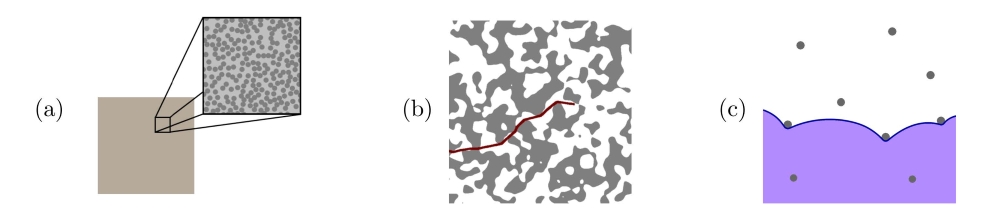
scopic heterogeneities often behave on large scales like a homogeneous effective material. (b) A
growing crack in a random medium. (c) An interface pinned by random inhomogeneities.
3.2 Research in Focus
The classical equations of continuum mechanics – such as the Navier-Stokes equation describing the velocity in fluid flow or the diffusion equation describing the density of a diffusing quantity – provide an accurate description of nature on macroscopic length scales. In microscopic “fluids” consisting only of 104–107 molecules, new phenomena due to the finite number of molecules arise; in particular, thermal fluctuations become important. Physicists have successfully accounted for these effects by augmenting the classical equations of continuum mechanics with noise terms, giving rise to a description based on stochastic partial differential equations (SPDEs). While this approach of fluctuating hydrodynamics has successfully extended the range of validity of continuum theories to substantially smaller length scales, a rigorous mathematical justification had remained elusive even for some of the most basic equations.
In a series of recent works starting with [2], we have built a rigorous foundation for one of the most basic fluctuating hydrodynamics models: The Dean-Kawasaki equation (written here in the non-interacting case) describes a diffusion process in a microscopic fluid, with N denoting the number of diffusing particles and with denoting space-time vectorial white noise. A major obstacle to the rigorous mathematical justification of the Dean-Kawasaki equation is its highly singular structure: In particular, it cannot be renormalized by approaches such as regularity structures or paracontrolled calculus. Starting with [2], we have proved that formal numerical discretizations of the Dean-Kawasaki equation correctly predict density fluctuations in the underlying particle system, to arbitrary order in the inverse particle number −1 and provided that the discretization is not too fine. This provides a rigorous justification for the practical use of the Dean-Kawasaki equation in physics: The Dean-Kawasaki equation may be regarded as a “recipe for coarse-graining” of the underlying particle dynamics.
Recently, we have developed and analyzed a multilevel Monte Carlo scheme [5] to further accelerate simulations based on the Dean-Kawasaki equation.

