Massive Binary Stars
Astronomy

Ylva Götberg
Assistant Professor
1 Career
- Since 2023 Assistant Professor, Institute of Science and Technology Austria (ISTA)
- 2020 – 2023 NASA Hubble Postdoctoral Fellowship, The Observatories of the Carnegie Institution for Science, California, USA
- 2019 – 2020 Alvin E. Nashman postdoctoral fellow in theoretical astrophysics, The Observatories of the Carnegie Institution for Science, California, USA
- 2014 – 2019 PhD student, Anton Pannekoek Institute for Astronomy, University of Amsterdam, The Netherlands. Graduation date: 2019/02/07
1.1 Selected Distinctions
- 2021, 2023, 2026 Selected reviewer for a prestigious fellowship for graduate students in astronomy in the USA, for a prestigious postdoctoral fellowship for astronomers based in the USA, for large research grants for junior professors from a large scale European research foundation, and for large research funds granted in The Netherlands. Confidentiality prohibts specifications to be shared.
- 2024 TIME100 Next honoree 2024 (https://time.com/collection/time100-next-2024/). The TIME magazine selects 100 people worldwide who are considered to already have made an impact in their field and are promising future leaders. Press release resulted in numerous newspaper articles (example article) and a radio interview.
- Since 2021 Time and Funding Allocation Related to Telescopes I have served on the scientific evaluation committee for time allocation and granting funding for two well-known telescopes. Confidentiality prohibts specifications to be shared.
- Since 2021-present Science team member, Ultraviolet Explorer (UVEX), an approved NASA/MIDEX mission with launch planned in 2030. I proposed and developed science related to the Magellanic Cloud survey.
- Since 2022 Point of Contact, working group 10, X-Shooting ULLYSES (XShootU) team. This collaboration is based on > 120 hours of ESO:VLT/X-SHOOTER time meant for following up massive stars that are part of the ULLYSES HST treasury program. I organized and hosted the last collaboration meeting at ISTA in May 2025.
1.2 Selected Grants
- 2025 European Research Council Starting Grant, PI: Goötberg, Project #: 101222457, 2SStars – Binary-Stripped Stars: from Atomic Scales to Cosmic Dawn € 1,500,000.
- 2022 HST/COS (GO-17123, 9 orbits, Cycle 30), PI: Götberg, $ 139,474.
- 2022 The 2022 Thacher Award for outstanding postdoctoral research, PI: Götberg, $ 5,000.
- 2020 NASA Hubble Postdoctoral Fellowship, PI: Götberg, $ 233,759.
- 2019 Carnegie-Canada grant for collaborations with Canadian institutions, PI: Götberg, $ 16,500.
- 2019 The Alvin E. Nashman postdoctoral fellowship for Theoretical Astrophysics, PI: Götberg, $ 207,000.
1.3 Tech Transfer (Patents, Spin-Offs)
N/A
1.4 Selected Publications
- A constant upper luminosity limit of cool supergiant stars down to the extremely low metallicity of I Zw 18 by Schootemeijer, Götberg et al., 2026, Astronomy & Astrophysics, 707, 116. Citations: 2.
- A high fraction of close massive binary stars at low metallicity by Sana et al., incl. Götberg, 2025, Nature Astronomy, 9, 1337–1346. Citations: 21.
- The mass distribution of stars stripped in binaries: The effect of metallicity by Hovis-Afflerbach, Götberg et al., 2025, Astronomy & Astrophysics, 697, A239. Citations: 17.
- An observed population of intermediate-mass helium stars that have been stripped in binaries by Drout & Götberg (shared first author) et al., 2023, Science, 382, 1287–1291. Citations: 85.
- Stellar Properties of Observed Stars Stripped in Binaries in the Magellanic Clouds by Götberg et al., 2023, Astrophysical Journal, 959, 125. Citations: 82.
- Spectral models for binary products: Unifying subdwarfs and Wolf-Rayet stars as a sequence of stripped-envelope stars by Götberg et al., 2018, Astronomy & Astrophysics, 615, A78. Citations: 217.
2 Group Members
- Andrei-Alexandru Cristea, PhD Student since 2023
- Debasish Dutta, PhD Student since 2024
- Dandan Wei, Postdoc since 2024
3 Research
Stars stripped of their hydrogen-rich envelopes are the exposed helium cores of their progenitors. These “stripped stars” are expected to be hot , compact , helium rich and hydrogen poor. With these unique properties, they are considered to be the main progenitors of hydrogen-poor supernovae, necessary for the creation of binary neutron stars that merge in gravitational wave events, and to emit copious amounts of ionizing radiation that directly influence interstellar and intergalactic gas.
While their existence was first predicted in the 1950’s, these stripped stars were first discovered recently. We used UV images to identify hot sources, which we followed up with optical spectroscopy. We then used the spectra to measure stellar properties and confirm the stripped nature. This technique was developed based on my evolutionary, spectral and population models.
Observed stripped stars are utterly useful for understanding many aspects of astronomy. Their winds af-fect what the supernova type is. The rotation rate sets the spin of the compact objects they evolve into. And, stripped stars should be so hot that their radiation even can ionize helium. We are currently taking full advan-tage of stripped star observations to develop theory and understanding of how massive stars evolve and interact with their surroundings.
3.1 Current Scientific Projects/Directions
- Winds from stripped stars – my PhD student Debasish Dutta is measuring the wind mass loss from stripped stars using data from the Hubble Space Telescope. This will lead to a first, observationally anchored wind prescription that can be used in both evolutionary and population models.
- Predictions for rotation of massive stellar cores – my PhD student Andrei Cristea is modeling the angular momentum transport inside massive stars. The result will be a testable prediction of spin rates of stripped stars, which are exposed cores of massive stars.
- Stripped star rotation measurements – PhD student A. Denney of my collaborator M.R. Drout is measuring the rotation rate of stripped stars using optical spectroscopy. The observational constraints will be used to understand how angular momentum is transported in stars by comparing with the predictions from my PhD student A. Cristea.
- Binary properties of stripped stars – PhD student A. Laroche of my collaborator M.R. Drout is measuring the binary orbital parameters of stripped stars using data that I obtained during a large and long program at the Magellan Observatory. The article is almost ready for submission and it contains binary fraction, orbital periods, and mass estimates for the unseen companions.
- Evolutionary history of stripped stars – ISTA postdoctoral fellow Dandan Wei is using observational constraints from A. Laroche to understand how stripped stars are formed. Her first article is focused on the very poorly understood process known as common envelope evolution, where she has impactful results.
- Magnetic fields of stripped stars – Previous MSc student G. Stimamiglio of collaborator S.E. de Mink explored whether the surfaces of stripped stars should be magnetized. If observed, the results have constraining power for how angular momentum is transported inside stars. G. Stimamiglio has written an article draft and it will likely be ready for submission in the fall.
- An ultratight stripped star binary – Previous PhD student B. Ludwig of my collaborator M.R. Drout measured the orbital parameters for one stripped star with a very short period, indicative of a compact companion. The article is being prepared for submission to Nature Astronomy.
- Carbon and Nitrogen in stripped stars – Previous ISTern B. Burt is preparing an article containing her measurements of the carbon and nitrogen abundances of observed stripped stars. The results have implications for both the evolutionary history, for the metal content of the stars, and for how processes in the deep interiors of massive stars work.
- Magnetic stars in a population – PhD student V. Ramirez-Delgado of collaborator V. Petit is revising a manuscript that is close to acceptance on how easy it is to identify that a massive star was born magnetic. The work contains a first published version of the population synthesis code I wrote for magnetic stellar populations.
- Spectral binary population synthesis – I am working on a series of articles about observability of the stripped star population in the Milky Way. The three articles are based on the spectral binary population synthesis code I wrote myself, and which has better representations of stripped stars than any other existing code. I also collaborate with the POSYDON team to help them implement spectral models in their large code effort.
- A catalog of optical spectra for UV bright objects – My close collaborator M.R. Drout is leading our efforts in publishing optical spectra of objects that we either do not exactly know what they are, or that simply were contaminating our observations. This catalog is an important step in both sparking ideas and to make data available to the public.
- Pulsations of stripped stars – I am leading a computational project for predicting the asteroseismologi-cal signals of stripped stars. The impact may be large, for example including tracers for mass and mixing regions.
- UVEX: A new UV satellite – I have been part of the science team of NASA’s accepted MIDEX mission UVEX since we created the science case. It is scheduled for launch in 2030. We are currently writing an article with more detailed descriptions about what observations will be taken during the first 2 years of operation.
- Mapping low metallicity stars – I am part of a collaboration led by G. O¨ stlin from Stockholm University in which we obtained a large amount of data of an extremely metal-poor star-forming galaxy from the Hubble Space Telescope. These data provide very valuable benchmarks for stellar evolution models.
3.2 Research in Focus
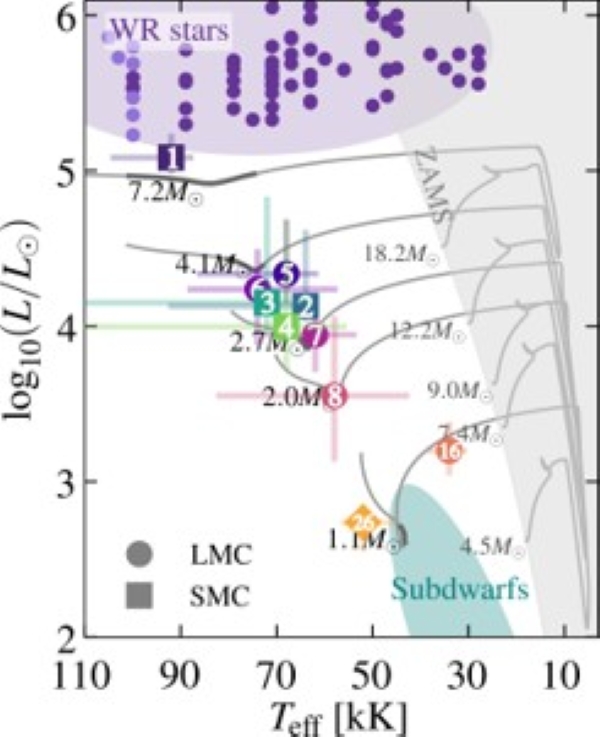
Binary-stripped stars, sufficiently massive to reach supernova, were mere theoretical concepts until 2023. In Götberg et al., 2023, we proved that a set of stars that we observed match our expectations for how stripped stars should look like.
We did this by fitting their optical spectra with a large grid of spectral models. By finding the well-fitting models, we could measure the stellar parameters. The optical spectra were observed using a spectrograph called MagE that is mounted on the 6.5 meter large telescope called Magellan/Baade at Las Campanas Observatory in Chile, and I computed the spectral model grid with a code called CMFGEN that is meant for modeling hot stars. I have made both the observed spectra and the model grids publicly available.
Figure 1 shows a comparison between measurement from the observations with predictions from binary evolution models. The axes trace the stars’ surface temperature (Teff) and the luminosity. The colored markers and errorbars indicate the measured parameters, while the gray lines display predictions from binary evolution models. From the evolution models, we expect stripped stars to be located primarily where the gray line is thicker. This is a good match with where the data lies. We can also se that the stripped stars create, as predicted, a bridge between the low-mass subdwarfs and the massive Wolf-Rayet (WR) stars.
This study was published in the Astrophysical Journal and its companion article, which describes how the stars were discovered was published in Science. I was the first author of both articles.