
Quantum Sensing with Atoms and Light
Physics

Onur Hosten
Assistant Professor
1 Career
- Since 2018 Assistant Professor, Institute of Science and Technology Austria (ISTA)
- 2015 – 2018 Research Scientist, Stanford University, USA
- 2010 – 2015 Postdoctoral Scholar, Stanford University, USA
- 2005 – 2010 PhD Physics, University of Illinois at Urbana-Champaign, USA
- 2003 – 2005 M.S. Physics, University of Illinois at Urbana-Champaign, USA
- 1999 – 2003 B.S. Physics Engineering – valedictorian, Hacettepe University, Republic of Türkiye
1.1 Selected Distinctions
- 2018 – 2026 44 invited lectures at conferences and institutional seminars since joining ISTA
- 2023 ERC Consolidator Grant
- 2018 Tenure track assistant professor offers at Colombia university, and TU Delft (declined)
- 2011 American Physical Society Outstanding Doctoral Thesis in AMO Physics (finalist)
1.2 Selected Grants
- 2024 – 2026 quantA CoE (FWF), Controlled hybrid gravitational and electromagnetic interactions near the quantum regime (lead PI, co-investigators: Peter Asenbaum ÖAW, Markus Aspelmeyer UNIVIE, Carlos Gonzalez-Ballestero TUW). Own share € 236,730.
- 2023 – 2028 ERC CoG, A quantum hybrid of atoms and milligram-scale pendulums: towards gravitational quantum mechanics. € 2,000,000.
- 2023 – 2024 FFG Spin-off, Tunable ultra-low noise lasers of the future, fellow Fritz Diorico € 493,052.
1.3 Tech Transfer (Patents, Spin-Offs)
Patents
- F. Diorico, O. Hosten, “A closed loop method and a system for controlling an injection-locked laser”, EP 22194904.3 (2022).
- F. Diorico, O. Hosten, “A robust modulation-free locking of a laser-cavity system”, EP 21216871.0 (2021).
Startup
1.4 Selected Publications
- S. Agafonova, P. Rossello, M. Mekonnen, O. Hosten, “1-milligram torsional pendulum for experiments at the quantum-gravity interface”, Commun. Phys 9, 80 (2026). https://doi.org/10.1038/s42005-026-02514-w
- M. Galanis, O. Hosten, A. Arvanitaki, S. Dimopoulos, “Superradiant interactions for relic detection with entangled nuclear spins”, Phys. Rev. A – Accepted 27 April, (2026). https://doi.org/10.1103/z2d9-4gv6
- S. Agafonova, U. Mishra, F. Diorico, O. Hosten, “Zigzag optical cavity for sensing and controlling torsional motion”, Phys. Rev. Research 6, 013141 (2024). https://doi.org/10.1103/PhysRevResearch.6.013141
- F. Diorico, A. Zhutov, O. Hosten, “Laser-cavity locking utilizing beam ellipticity: accessing the 10−7 instability scale relative to cavity linewidth”, Optica 11, 26 (2024). https://doi.org/10.1364/OPTICA.507451
- O. Hosten, “Constraints on probing quantum coherence to infer gravitational entanglement”, Phys. Rev. Research 4, 013023 (2022). https://doi.org/10.1103/PhysRevResearch.4.013023
2 Group Members
- Sofia Agafonova, PhD Student since 2021
- Edward Gheorghita, PhD Student since 2023
- Alexei Gurchenko, PhD Student since 2024
- Gabriela Guzman, PhD Student since 2025
- Umang Mishra, PhD Student since 2022
- Andrea Pupic, PhD Student since 2025
- Marta Marchese, Postdoc since 2025
- Teodor Strömberg, Postdoc since 2024
3 Research
Can we combine atomic, optical, and mechanical systems to open a new frontier for probing the quantum nature of gravity – or perhaps uncover evidence that such a quantum nature does not exist? Experimental exploration of the multifaceted challenges behind this question has captivated my interest in recent years and has become a central focus of my research. Recent developments in quantum science and precision measurements suggest the timeliness of developing methods and building the first experiments aimed at probing the quantum-gravity interface.
In my group, we aim to develop innovative techniques to control quantum properties of atomic, optical and mechanical systems with an eye towards applications in the domain of quantum-enabled technologies, precision sensing, and fundamental science. By manipulating the collective properties of cold atomic ensembles in optical cavities, or mechanical systems coupled to optical cavities, our group seeks to investigate and gainfully utilize concepts of quantum entanglement, quantum measurement, and light-assisted atomic interactions to develop new sensing techniques, e.g., for force or acceleration sensing, or making ultra-precise clocks, while gaining insight into fundamental aspects of quantum mechanics. Using these sensors, the long-term goal is to explore challenging experimental questions at the interface of quantum mechanics and gravity.
3.1 Current Scientific Projects/Directions
- Milligram-scale oscillators in the quantum regime
- Gravity at the 1-milligram mass scale
- Motionally entangled atoms in optical cavities
- Quantum hybrids of mechanical oscillators and cold atoms
- Disruptive methods for laser technologies
3.2 Research in Focus
The question of whether gravitational fields must be quantized has been debated for decades. Recent theoretical proposals suggest that emerging capabilities in quantum optomechanics could make it possible to experimentally test gravitationally mediated entanglement – a signature of quantum gravitational effects.
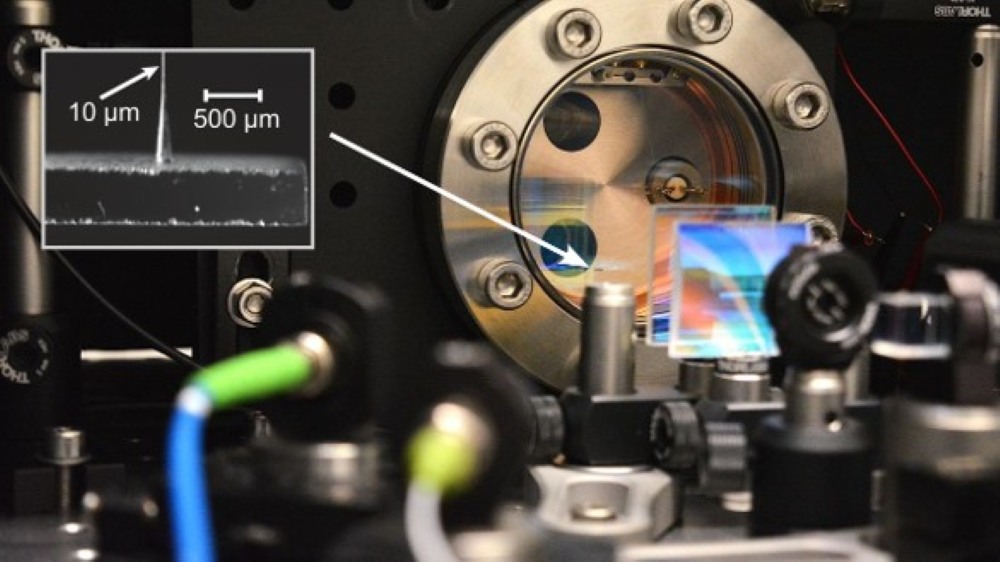
We are advancing this frontier by developing milligram-scale suspended torsional pendulums as a platform for such investigations. The first challenge is to bring these mechanical systems into the quantum noise–dominated regime. To this end, we laid the experimental groundwork and quantitatively benchmarked the utility of our platform relative to other optomechanical systems, many of which already operate in the quantum regime. We refined a figure-of-merit for evaluating experimental viability at the quantum-gravity interface, providing a comparative context and setting a performance benchmark for the field. We developed and brought under control an optomechanical system based on a 1-milligram torsional oscillator operating at 18 Hz. Using radiation pressure for active feedback, we cooled the torsional motion to 240 mK, enhancing the oscillator’s quantum coherence length. This achievement established a quantum-gravity figure of merit that surpasses all previous tabletop experiments, ranking second only to LIGO – a platform not easily extendable to this domain. Our experiment demonstrated both the coldest actively cooled mechanical oscillator by a factor of 20 in the 100 ng to 10 kg mass range and the highest torque sensitivity achieved at the milligram scale. This work was published in Communications Physics: S. Agafonova et. al, Commun. Phys 9, 80 (2026).

