Neuroethology
Neuroscience

Maximilian Jösch
Professor
1 Career
- Since 2025 Professor, Institute of Science and Technology Austria (ISTA)
- 2017 – 2025 Assistant Professor, Institute of Science and Technology Austria (ISTA)
- 2010 – 2016 Postdoc, Harvard University, Cambridge MA, USA
- 2005 – 2009 PhD, Max Planck Institute for Neurobiology, Martinsried, Germany
1.1 Selected Distinctions
- 2018 – 2023 FENS-Kavli Network of Excellence, Scholar
- 2011 Otto Hahn Medal / Max Planck Society
- 2010 – 2013 HFSP Postdoctoral
1.2 Selected Grants
- 2023 ERC CoG – Action Selection in the Midbrain: Neuromodulation of Visuomotor Senses – European Research Council.
- 2019 & 2023 Evolution of Sensorimotor Transformations, DFG Priority Program: “Evolutionary Optimisation of Neuronal Processing”.
- 2017 ERC StG – Circuits of Visual Attention – European Research Council.
1.3 Tech Transfer (Patents, Spin-Offs)
N/A
1.4 Selected Publications
- A thalamic hub-and-spoke network enables visual perception during action by coordinating visuomotor dynamics. Vega-Zuniga, Sumser, Symonova,.., Joesch M. Nature Neuro. (2025).
- Gap junctions coordinate binocular course control in flies. Pokusaeva VO*, Satapathy R*, Symonova O, Joesch M. Nature Comm. (2023).
- Behavioral impairments in visual perception and place avoidance are shared across different autism models and driven by potassium channel hypoexcitability in Setd5 haploinsufficient mice. Burnett LE, Koppensteiner P, … Joesch M. Plos Biol. (2024).
- Gupta D*, Młynarski W*, Sumser A*, Symonova O, Svatoň J, Joesch M. Panoramic visual statistics shape retina-wide organization of receptive fields. Nature Neuro. (2023).
- Fredes, F., Silva, M. A., Koppensteiner, P., Kobayashi, K., Joesch, M.# & Shigemoto, R.# Ventro-dorsal Hippocampal Pathway Gates Novelty-Induced Contextual Memory Formation. Curr. Biol. (2021).
2 Group Members
- Rimma Bondarenko, PhD Student since 2023
- Gloria Fuhrmann, PhD Student since 2025
- Dafna Ljubotina, PhD Student since 2023
- Josefine Meyer, PhD Student since 2025
- Anuj Patel, PhD Student since 2023
- Eleonora Quiroli, PhD Student since 2021
- Florian Schmidt, PhD Student since 2020
- Ece Sönmez, PhD Student since 2021
- Kuwook Cha, Postdoc since 2026
- Luka Gantar, Postdoc since 2025
- Gabor Lengyel, Postdoc since 2025
- Tomas Masson, Postdoc since 2021
- Olga Symonova, Data Scientist since 2018
3 Research
In an ever-changing natural world, animals must continuously adapt their behavior by extracting relevant information from complex sensory environments in a context-dependent manner. The significance of sensory inputs is not fixed, but rapidly reshaped by internal states, prior experience, attention, and behavioral goals. At the same time, neural systems must perform these computations efficiently, constrained by ecological demands and evolutionary history. My research addresses this challenge using sensorimotor transformations as a unifying framework, bridging systems, computational, and biophysical neuroscience.
A central focus is the superior colliculus (SC), a conserved midbrain structure that converts visual inputs into goal-directed actions. Rather than acting as a simple relay, the SC emerges as a dynamic hub where sensory representations are continuously shaped by neuromodulatory feedback. Signals related to arousal, reward, and risk interact with early visual processing, indicating that perception is fundamentally context-dependent. By combining large-scale recordings, circuit perturbations, and behavioral assays, we investigate how neuromodulation restructures circuit dynamics and guides action selection.
In parallel, my work on the evolution of sensorimotor transformations in Diptera examines how conserved circuit architectures give rise to species-specific behaviors. By integrating genetic, anatomical, and computational approaches, we study how evolutionary pressures shape neural algorithms to match ecological demands. Together, these efforts aim to uncover general principles by which neural systems flexibly integrate sensory inputs and internal states to generate adaptive behavior.
3.1 Current Scientific Projects/Directions
- Contextual inference in the early visual system of mice
- Balancing invariance and efficiency in neural processing
- Attentional modulation in early visual circuits of flies and mice
- Corollary discharge and visual signal correction
- Contextual inference in mice and flies
- Neuromodulatory control of visual processing
- Evolution of sensorimotor transformations in Diptera
- Adaptation to natural statistics in the visual system of flying mammals
- Molecular determinants of neuronal wiring in early visual circuits of flies and mice
3.2 Research in Focus
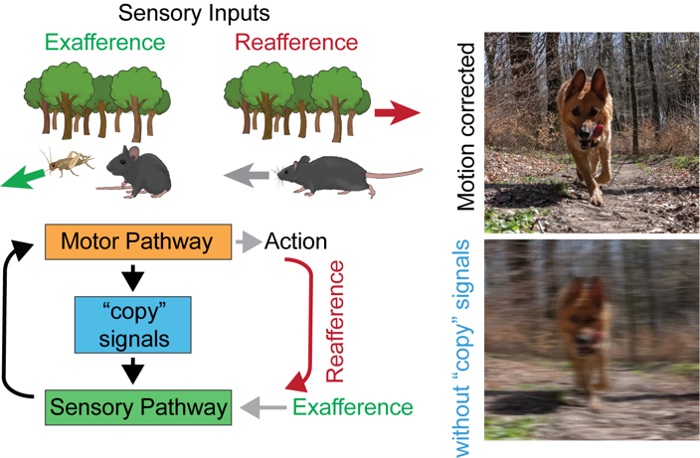
To understand the world accurately, the brain must distinguish between what we see due to external events and what arises from our own movements. This is challenging, as our actions are complex and constantly changing. We found that the brain uses signals related to its own motion—such as walking or changes in pupil size—to adjust visual processing at a very early stage. Specifically, a pathway sends “copy” signals about ongoing movements to an early visual center, helping to suppress or adjust incoming visual input when it is self-generated. Remarkably, this modulation occurs at one of the earliest stages of visual processing in the brain, immediately after information arrives from the eye. Although our study was performed in mice, the same brain structures are conserved across vertebrates, including humans. When we manipulated this pathway, it not only altered visual perception but also influenced the animal’s movements. This demonstrates that the brain actively predicts and corrects for the sensory consequences of its own actions. Overall, our findings reveal a fundamental mechanism that enables the brain to maintain stable and accurate perception while moving through the world.
Vega-Zuniga, et al. Nature Neuro. (2025)