
Self-Organization of Protein Systems
Biology

Martin Loose
Professor
1 Career
- Since 2021 Professor, Institute of Science and Technology Austria (ISTA)
- 2015 – 2021 Assistant Professor, Institute of Science and Technology Austria (ISTA)
- 2011 – 2014 Departmental fellow, Harvard Medical School, Boston, USA
- 2010 – 2011 Postdoc, Technical University Dresden, Germany
- 2006 – 2010 PhD student (Biology), Technical University Dresden, Germany
1.1 Selected Distinctions
- 2020 Member of the EMBO Young Investigator Program
- 2012 HFSP Long-Term Fellowship
- 2011 EMBO Long-Term Fellowship
- 2010 Dr.-Walter-Seipp-Dissertation Award of the TU Dresden
1.2 Selected Grants
- 2025 – 2028 FWF Principal Investigator Grant, “Mechanisms and evolution of FtsZ regulation”, Grant No. PAT1394325, € 441,380.
- 2023 – 2028 ERC Consolidator Grant, “GTPaseNet”, Grant No. 101045340, € 1,928,624.
- 2021 – 2024 FWF Standalone Grant, “In vitro reconstitution of bacterial cell division”, Grant No. P34607, € 388,818.
- 2016 – 2021 Human Frontiers Science Program, Young Investigator Grant, “Reconstitution of cell polarity and axis determination in a cell-free system”, Grant No. RGY0083/2016, $ 337,500.
- 2016 – 2021 ERC Starting Grant, “Self-organization of the bacterial cell”, Grant No. 679239, € 1,496,687.
1.3 Tech Transfer (Patents, Spin-Offs)
N/A
1.4 Selected Publications
- Springstein, B.L., Javoor, M.G., Megrian, D., Hajdu, R., Hanke, D.M., Zens, B., Weiss, G.L., Schur, F.K.M., and Loose, M. (2026). Repurposing of a DNA segregation machinery into a cytoskeletal system controlling cell shape. Science 392, eaea6343. https://doi.org/10.1126/science.aea6343.
- Dunajova, Z., Mateu, B.P., Radler, P., Lim, K., Brandis, D., Velicky, P., Danzl, J.G., Wong, R.W., Elgeti, J., Hannezo, E., et al. (2023). Chiral and nematic phases of flexible active filaments. Nat. Phys. 19, 1916–1926.https://doi.org/10.1038/s41567-023-02218-w.
- Radler, P., Baranova, N., Caldas, P., Sommer, C., López-Pelegrín, M., Michalik, D., and Loose, M. (2022). In vitro reconstitution of Escherichia coli divisome activation. Nat. Commun. 13, 2635. https://doi.org/10.1038/s41467-022-30301-y.
- Baranova, N., Radler, P., Hernández-Rocamora, V.M., Alfonso, C., López-Pelegrín, M., Rivas, G., Vollmer, W., and Loose, M. (2020). Diffusion and capture permits dynamic coupling between treadmilling FtsZ filaments and cell division proteins. Nat Microbiol 5, 407–417. https://doi.org/10.1038/s41564-019-0657-5.
- Bezeljak, U., Loya, H., Kaczmarek, B., Saunders, T.E., and Loose, M. (2020). Stochastic activation and bistability in a Rab GTPase regulatory network. Proc National Acad Sci 117, 6540–6549. https://doi.org/10.1073/pnas.1921027117.
2 Group Members
- Roman Hajdu, PhD Student since 2023
- Ivana Matijevic, PhD Student since 2022
- Arsenii Solovev, PhD Student since 2023
- Chiara Bosetti, Postdoc since 2025
- Himani Khurana, Postdoc since 2024
- Ashwini Krishna, Postdoc since 2025
- Biswaprakash Mahanta, Postdoc since 2025
- Benjamin Springstein, Postdoc since 2023
- Xing Ye, Postdoc since 2021
- Anita Carija, Research Technician since 2021
3 Research
Our research group investigates the emergent properties of protein networks that govern cellular organization. We employ a combination of in vitro reconstitution and quantitative microscopy, and collaborate with experts in computational modeling and evolutionary analyses to uncover mechanistic principles of self-organization in diverse molecular systems and model organisms. Our work largely focuses on two interconnected research directions: the regulation of bacterial cytoskeletal systems and the regulatory networks of small GTPase that control membrane identities. A central focus is bacterial cell division, where we study how the tubulin homolog FtsZ assembles into treadmilling filaments and organizes into the Z-ring — the cytoskeletal structure that drives cytokinesis in Escherichia coli. Using purified proteins and model membranes, we have revealed how FtsZ dynamics spatially coordinate division proteins through diffusion-and-capture, and how regulatory proteins modulate filament organization to control division in space and time. In parallel, we investigate the regulatory networks of small Rab GTPases, which define the biochemical identities of organelles in eukaryotic cells. By reconstituting these networks in vitro, we have demonstrated emergent properties such as bistability, ultrasensitivity, and spatial self-organization, providing a mechanistic framework for robust membrane trafficking. Most recently, we have extended our work to novel cytoskeletal systems in cyanobacteria, discovering how ancient protein machineries can be evolutionarily repurposed to control new cellular functions.
3.1 Current Scientific Projects/Directions
- Evolution, biophysics and regulation of cytoskeletal systems in bacteria and archaea
- Emergent properties and regulatory networks of small GTPases
3.2 Research in Focus
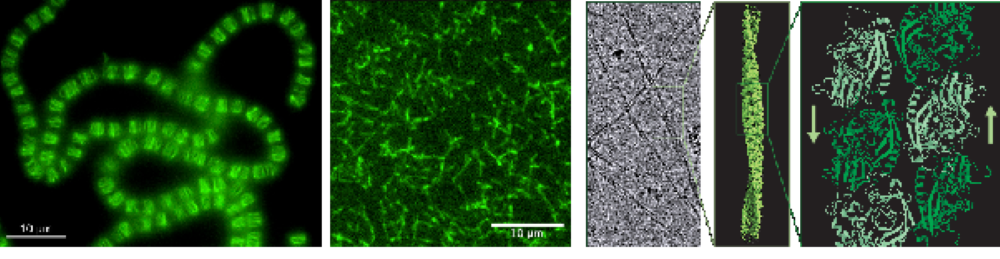
Cytoskeletal systems provide internal protein scaffolds that give cells their shape and organize their contents. In this recent paper, we asked the question about how these complex cellular structures evolve. One such system, the plasmid-encoded ParMR module, forms actin-like filaments that push low–copy number plasmids to opposite sides of a dividing cell, ensuring that each daughter cell inherits equal DNA. In multicellular cyanobacteria such as Anabaena sp., we found that a chromosomally encoded ParMR system has evolved into a cytoskeletal system named CorMR with a function in cell shape control rather than DNA segregation. Live-cell imaging, biochemical in vitro reconstitution experiments, and cryo–electron microscopy revealed that CorM formed dynamically unstable, antiparallel double-stranded filaments that were recruited to the membrane by CorR through an amphipathic helix conserved in multicellular cyanobacteria. CorMR filaments were regulated by MinC, which excluded them from the poles and division plane. Comparative genomics indicated that this repurposing of ParMR and Min systems coevolved with cyanobacterial multicellularity, highlighting the evolutionary plasticity of bacterial cytoskeletal systems and illustrating how existing biochemical modules can be coopted to support new functions during the evolution of multicellularity.
Right: Transmission spectrum of the cavity containing a single rubidium atom positioned at the antinode of the cavity mode.

