Atmosphere and Ocean Dynamics
Earth Science

Caroline Muller
Professor
1 Career
- Since 2024 Professor, Institute of Science and Technology Austria (ISTA)
- 2021 – 2024 Assistant Professor, Institute of Science and Technology Austria (ISTA)
- 2012 – 2021 Permanent researcher, CNRS France
- 2015 – 2021 Lecturer, ENS Paris – joint appointment with CNRS, France
- 2010 – 2012 Associate Research Scholar, Princeton University, USA
- 2008 – 2010 Postdoctoral Associate, MIT, USA
- 2008 PhD, New York University, Courant Institute of Mathematical Sciences, USA
1.1 Selected Distinctions
- 2026 Visiting Miller Research Professor, University of California Berkeley
- 2025 Conference Organizer “Theoretical Challenges for Ocean Dynamics”, ENS Lyon
- 2025 Keynote Speaker, Global hackathon, MPI-Meteorology Hamburg
- 2024 PhD prize for PhD student Sophie Abramian, The Fondation Des Treilles
- 2012–2017 Director of the graduate summer school “Fluid Dynamics of Sustainability and the Environment” (FDSE) Ecole Polytechnique & the University of Cambridge
1.2 Selected Grants
- 2025 – 2026 ISTA Interdisciplinary Projects “Data-driven theory for cloud dynamics”. Awarded: € 100,000.
- 2019 – 2025 ERC Starting Grant, “organization of CLoUdS and implications for Tropical cyclones and for the Energetics of the tropics, in current and in a waRming climate” CLUSTER. Awarded: € 1,080,000.
- 2021 – 2022 ESA Grant “Science Data Utilisation and impact study for the ocean”. Coordinator: Paco Lopez-Dekker TU Delft. Awarded to CM: € 20,000.
1.3 Tech Transfer (Patents, Spin-Offs)
N/A
1.4 Selected Publications
- J. Bao et al., “Tropics-wide intraseasonal oscillations”, Proceedings of the National Academy of Sciences, 122 (48), Nov. 2025, e2511549122, https://doi.org/10.1073/pnas.2511549122.
- S. Abramian et al., “How key features of early development shape deep convective systems”, npj climate and atmospheric science, 8, 258, July 2025, https://doi.org/10.1038/s41612-025-01154-1.
- J. Bao et al., “Intensification of daily tropical precipitation extremes from more organized convection”, Science Advances, Vol 10, Issue 8, Dec. 2025, DOI: 10.1126/sciadv.adj6801.
- L. Agasthya et al., “Moist convection and radiative cooling: Dynamical response and scaling”, Quarterly Journal of the Royal Meteorological Society, e70044, Sept. 2025, https://doi.org/10.1002/qj.70044.
- A. Polesello et al., “Intensity Oscillations of Tropical Cyclones: Surface Versus Mid and Upper Tropospheric Processes”, Journal of Advances in Modeling Earth Systems, 17,e2024MS004613, Mar. 2025, https://doi.org/10.1029/2024MS004613.
2 Group Members
- Alex Charinti, PhD Student since 2023
- Sima Dogan, PhD Student since 2022
- Bety Pechacova, PhD Student since 2025
- Andrea Polesello, PhD Student since 2024
- Andrea Stöllner, PhD Student since 2022 (co-advised with Scott Waitukaitis)
- Bowen Yang, PhD Student since 2022 (co-advised with Bjorn Hof)
- Jiawei Bao, Postdoc since 2023
- Alejandro Casallas, Postdoc since 2024
3 Research
Every weather forecast, every climate projection, every flood warning we rely on is only as good as the models that produce them. Yet the most consequential processes driving our climate — the ocean waves that stir heat into the deep, the clouds that cool the tropics, the storms that drench coastlines — are too small and too fast for today’s global climate models to resolve directly. They must be approximated, and how well we approximate them determines how much we can trust what those models tell us about our future.
The Muller group works at this frontier. Using theory, high-resolution simulations, and observations from in-situ to satellites, we aim to understand these small-scale processes well enough to represent them accurately in coarse global climate models. Three questions sit at the heart of this effort: Why do extreme rainfall events intensify with warming, and how fast? What controls the self-organization of tropical clouds into structures as violent as cyclones? And how do internal waves — rippling unseen through the ocean interior — mix heat and energy across the global ocean circulation? The answers matter not just for science, but for every society that depends on reliable climate projections to plan for the decades ahead.
3.1 Current Scientific Projects/Directions
- Tropical energetics in a warming climate
- Data-driven theory for cloud dynamics
- Unraveling the physics of mesoscale convective systems
- Tropical cyclone formation and intensification
- Ocean-atmosphere interactions
3.2 Research in Focus
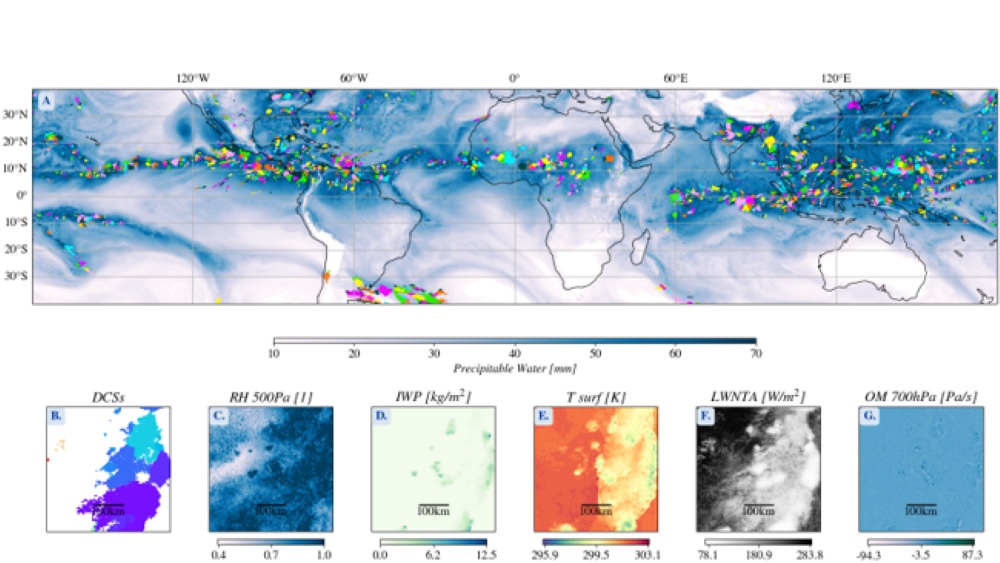
Tropical storms are among the most powerful and destructive phenomena on Earth. The largest of these Deep Convective Systems (DCSs) spanning hundreds to thousands of kilometers, are responsible for over half of all tropical rainfall, and their towering cloud shields play a major role in regulating Earth’s energy budget. Yet what ultimately determines whether a nascent storm grows into a giant, or fizzles out, has remained poorly understood. Is it the environment the storm is born into, or something intrinsic to the storm itself?
In our recent work Abramian et al.2025, we combined a global high-resolution atmospheric simulation with a sophisticated storm-tracking algorithm and machine learning to track the fate of over 68,000 tropical convective systems (Fig. 1). We find that the answer is written surprisingly early: a system’s growth rate during just the first two hours of its life predicts its eventual size with a reasonable score. Beyond this early window, growth rate alone becomes the dominant predictor. In the very first stages, however, additional factors come into play — the spatial heterogeneity of ice within the storm, interactions with neighboring systems, wind shear, and migration distance all leave a measurable imprint on the final outcome.
Crucially, the study quantifies for the first time the relative weight of internal versus external drivers: intrinsic system properties account for 40% of the variance in mature storm size, while environmental conditions account for only 26%. This imbalance becomes even more pronounced for the largest systems, where internal feedbacks account for nearly half of the variability. This suggests that large convective systems have the capacity to create their own favorable conditions, escaping the constraints of their initial environment to grow to mesoscale. This work was published in npj Climate and Atmospheric Science: S. Abramian et al., npj Clim. Atmos. Sci. 8, 258 (2025).