Geometric Computing and Digital Fabrication
Computer Science

Samara Ren
Assistant Professor
1 Career
- Since 2024 Assistant Professor, Institute of Science and Technology Austria (ISTA)
- 2019 – 2024 PhD, EPFL, Switzerland
1.1 Selected Distinctions
- 2025, 2026 SIGGRAPH Technical Papers Committee Member
- 2025 Eurographics PhD Award
- 2024 Doctoral Thesis Distinction, EPFL
1.2 Selected Grants
N/A
1.3 Tech Transfer (Patents, Spin-Offs)
N/A
1.4 Selected Publications
- Y. Ren, J. Panetta, S. Suzuki, U. Kusupati, F. Isvoranu, and M. Pauly, “Computational homogenization for inverse design of surface-based inflatables,” ACM Trans. Graph., vol. 43, no. 4, DOI: 10.1145/3658125. [Online]. Available: https://doi.org/10.1145/3658125.
- S. Sellán, Y. Ren, C. Batty, and O. Stein, “Reach for the arcs: Reconstructing surfaces from sdfs via tangent points,” in SIGGRAPH 2024 Conference Papers, 2024.
- M. Vidulis, Y. Ren, J. Panetta, E. Grinspun, and M. Pauly, “Computational exploration of multistable elastic knots,” ACM Trans. Graph., vol. 42, no. 4, 2023, issn: 0730-0301, 1557-7368. DOI: 10.1145/3592399. [Online]. Available: https://dl.acm.org/doi/10.1145/3592399.
- Y. Ren et al., “Umbrella meshes: Elastic mechanisms for freeform shape deployment,” ACM
Trans. Graph., vol. 41, no. 4, 2022, issn: 0730-0301, 1557-7368. DOI: 10.1145/3528223.3530089.
[Online]. Available: https://dl.acm.org/doi/10.1145/3528223.3530089. - Y. Ren et al., “3d weaving with curved ribbons,” ACM Trans. Graph., vol. 40, no. 4, 2021.
[Online]. Available: https://doi.org/10.1145/3450626.3459788.
2 Group Members
- Ladislav Trnka, PhD Student since 2026
- Peiyuan Xie, PhD Student since 2026
- Nicole Feng, Postdoc since 2026
- Carmen Farr, Research Technician since 2025
3 Research
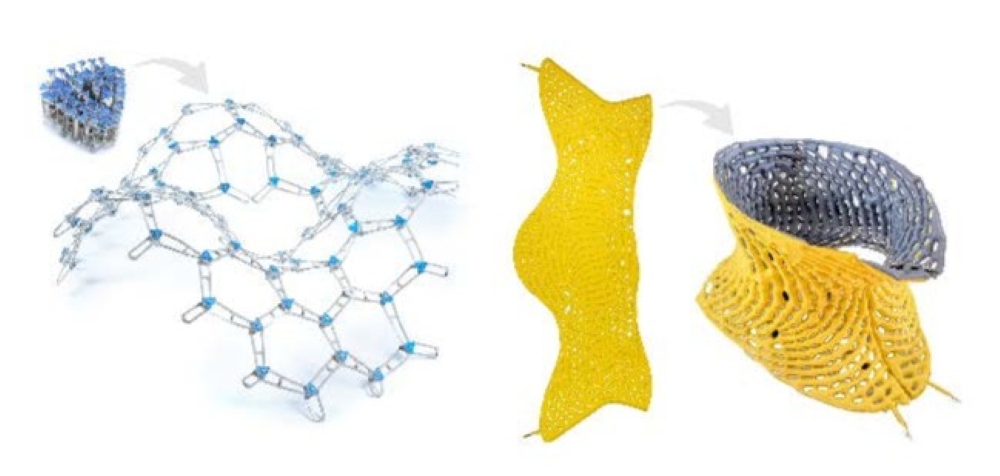
Our group focuses on research in geometry, simulation, and computational inverse design. Advancements in digital fabrication technology enable us to create structures featuring intricate geometric details. By developing computational methods, we can design shape-morphing structures that transfer the complexities of assembly, actuation, 3D shape approximation, and structural stability into their fabricated geometries.
We work on developing efficient geometric representations to model the physical systems, robust and accurate PDE solvers to simulate complex phenomena, and numerical optimization algorithms to navigate high-dimensional highly non-convex energy landscapes. We draw both inspiration and validation from practical applications, aiming to develop techniques that address real-world challenges.
3.1 Current Scientific Projects/Directions
- Designing Multistable Elastic Structures
- Fast Simulation of Semi-persistent Contacts
- Design Space of Closed Elastic Rods with Contacts
- Homogenization of Multi-chamber Inflatables
- Sparse Actuation for Deployable Structures
- Modular Origami
3.2 Research in Focus
By fusing two thin sheets of material at a sparse set of curves, we can transform the originally flexible and compact sheets into a deployable, load-bearing structure through inflation (see Figure 1 right). Choosing the location and geometries of the fusing curves is a challenging design problem, as the connection between the shape of the fusing curves and the equilibrium of the inflated state is highly nonlinear and nonconvex. To tackle this problem, we proposed a computational homogenization technique to characterize geometric and mechanical behavior of periodic inflatable patches with arbitrary fusing patterns, enabling systematic exploration of the design space of surface-based inflatables. By developing state-of-the-art optimization algorithms for anisotropic materials, we are able to produce a large range of inflatable structures that approximate complex 3D geometries and achieve superior structural performances. This work was published in SIGGRAPH 2024 (ACM Transactions on Graphics) [1].