
Biomolecular Mechanisms from Integrated NMR Spectroscopy
Chemistry

Paul Schanda
Professor
1 Career
- Since 2021 Professor, Institute of Science and Technology Austria (ISTA)
- 2010 – 2021 Group leader, Institut de Biologie Structurale, Grenoble, France
- 2008 – 2010 Postdoctoral Fellow, ETH Zürich, Switzerland
- 2005 Visiting scientist, Weizmann Institute of Science, Israel
- 2004 – 2007 PhD student, Université Joseph Fourier, Grenoble, France
- 2004 MSc (Chemistry), University of Vienna, Austria
1.1 Selected Distinctions
- 2022 HS Atreya Award from the Indian NMR Society
- 2020 Varian Young Investigator Award from the AMPERE society
- 2020 Founders’ Medal from the International Council on Magnetic Resonance in Biological Systems
- 2026 – 2029 Elected Council member of the International Society of Magnetic Resonance
- 2012 ERC Starting Grant
1.2 Selected Grants
- 2025 – 2028 FWF Grant ”Protein import mechanisms at the mitochondrial entry gate”: € 499k.
- 2023 – 2026 FWF Grant ”Structure and mechanism of the mitochondrial MIM insertase”: € 372k.
- 2022 – 2026 FWF-ANR Grant (Austria-France) ”AlloSpace. The emergence and mechanisms of allostery”: € 414k.
1.3 Tech Transfer (Patents, Spin-Offs)
- Patent “Inference-time optimization for experiment-grounded protein ensemble generation”.
1.4 Selected Publications
- L. M. Becker et al., “Aromatic ring flips reveal reshaping of protein dynamics in crystals and complexes,” Nature Chemistry, in press, 2026.
- B. P. Tatman et al., “Bumps on the road: The way to clean relaxation dispersion magic-angle spinning nmr,” Journal of the American Chemical Society, vol. 147, no. 32, pp. 29 315–29 326, 2025.
- L. Troussicot, A. Vallet, M. Molin, B. M. Burmann, and P. Schanda, “Disulfide-bond-induced structural frustration and dynamic disorder in a peroxiredoxin from mas nmr,” Journal of the American Chemical Society, vol. 145, no. 19, pp. 10 700–10 711, 2023.
- L. M. Becker et al., “The rigid core and flexible surface of amyloid fibrils probed by magic-angle-spinning nmr spectroscopy of aromatic residues,” Angewandte Chemie International Edition, vol. 62, no. 19, e202219314, 2023.
- M. Degen et al., “Structural basis of NINJ1-mediated plasma membrane rupture in cell death,” Nature, vol. 618, no. 7967, pp. 1065–1071, Jun. 2023.
2 Group Members
- Lea Marie Becker, PhD Student since 2021
- Undina Guillerm, PhD Student since 2023
- Maria Clara Miserendino, PhD Student since 2024
- Federico Napoli, PhD Student since 2021
- Darja Rohden, PhD Student since 2022 (co-supervised with Univ. of Vienna)
- Jakob Schneider, PhD Student since 2021
- Louis Brigandat, Postdoc since 2024
- Caroline Simoes Pereira, Postdoc since 2025
- Ben Tatman, Postdoc since 2024
- Anna Kapitonova, Research Technician since 2024
- Rajkumar Singh, Research Technician since 2023
3 Research
Proteins are dynamic molecules with a complex free-energy landscape, fluctuating among multiple
conformational states—each linked to biological function. While structural biology traditionally
focuses on rigid conformations, the Schanda group investigates how biomolecular dynamics enable
function, leveraging advanced Nuclear Magnetic Resonance (NMR) methods.
3.1 Current Scientific Projects/Directions
The group’s research spans methods development, fundamental protein dynamics, and biological questions:
- Methods development: NMR spectroscopy is expanded to reveal sparse, functionally crucial
protein conformations, often “invisible” in traditional studies. Machine learning is integrated to
enhance precision. - Protein dynamics: fundamental insights: Using advanced NMR and isotope labeling, the
group studies collective protein motions, such as “breathing” dynamics probed via aromatic rings
(Figure 1B), showing how intermolecular contacts shape protein behavior. - Functionally important dynamics of enzymes: Allosteric regulation of enzyme activity via
distant sites is central to cellular homeostasis. The group studies malate/lactate dehydrogenase to
uncover the underlying mechanisms and how allosteric networks evolved.
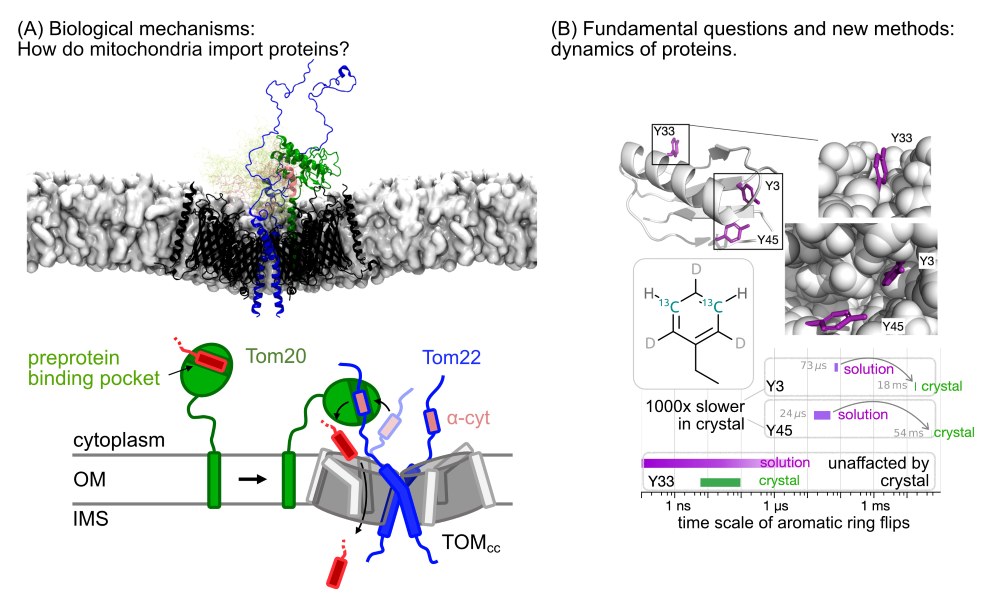
3.2 Research in Focus
Mitochondria, the ”power houses” of the cell, require more than 1000 different proteins to function; almost all of them are imported via a dynamic import machinery. The group combines NMR, cellular experiments, and computational modeling to study this process. Recent work (Figure 1A) revealed a novel mechanism: a flexible protein (blue) facilitates safe transfer through mitochondrial membranes. This work (Sucec et al., 2026, bioRxiv 10.64898/2026.01.14.699430, revision at Mol. Cell) opens avenues to modulate import with designed proteins (ongoing collaboration with ISTA and international partners).

