Evolution, Development, and Function of Motor Circuits
Neuroscience

Lora Sweeney
Assistant Professor
1 Career
- Since 2020 Assistant Professor, Institute of Science and Technology Austria (ISTA)
- 2011 – 2020 Postdoc, Salk Institute for Biological Studies, USA
- 2011 PhD, Stanford University, USA
1.1 Selected Distinctions
- 2026 Symposium Chair, Federation for European Neuroscience (FENS) Forum
- 2025 EMBO Young Investigator
- 2022 ERC Starting Grant
- 2021 FENS-Kavli Network of Excellence, Scholar and Vice-Chair
- 2019 Helmholtz Young Investigator Award, MDC Berlin and Helmholtz Foundation (declined)
1.2 Selected Grants
- 2022 – 2027 ERC-Starting Grant swim2limb (101041551), Development and Evolution of Tetrapod Motor Circuits, Awarded overall: € 1,500,000.
- 2024 – 2028 FWF-SFB NeuroStem (F7814), Stem Cell Modulation in Neural Development and Regeneration/ P14-Swim-to-limb transition: cell type to connection diversity, Awarded overall: € 5,424,141.52; Awarded to RG: € 413,173.26.
- 2021 – 2024 National Science Foundation EDGE Award, Development of Viral Vectors for Amphibian Gene Delivery and Manipulation, Awarded overall: $ 1,500,000; Awarded to RG: $ 374,000.
1.3 Tech Transfer (Patents, Spin-Offs)
N/A
1.4 Selected Publications
- Vijatovic, D., Toma, F. A., Ignatyev, Y., Harrington, Z. P., Sommer, C., Hauschild, R., … & Sweeney, L. B. (2026). Multifold increase in spinal inhibitory cell types with emergence of limb movement. Cell Reports, 45(4).
- Jaeger, E. C., Vijatovic, D., Deryckere, A., Zorin, N., Nguyen, A. L., Ivanian, G., … & Sweeney, L. B. (2025). Adeno-associated viral tools to trace neural development and connectivity across amphibians. Developmental Cell, 60(5), 794-812.
- Wilson AC, Sweeney LB. 2023. Spinal cords: Symphonies of interneurons across species. Frontiers in Neural Circuits. 17, 1146449.
- Kratsios, P., Zampieri, N., Carrillo, R., Mizumoto, K., Sweeney, L. B., & Philippidou, P. (2024). Molecular and cellular mechanisms of motor circuit development. Journal of Neuroscience, 44(40).
- Salamatina A, Yang JH, Brenner-Morton S, Bikoff JB, Fang L, Kintner CR, Jessell TM, Sweeney LB. 2020. Differential loss of spinal interneurons in a mouse model of ALS. Neuroscience. 450, 81–95.
2 Group Members
- Sophie Angeline Gobeil, PhD Student since 2022
- Iurii Ignatev, PhD Student since 2020
- Stavros Papadopoulos, PhD Student since 2021
- Florina-Alexandra Toma, PhD Student since 2021
- David Vijatovic, PhD Student since 2020
- Alexander Tianma Lin-Moore, Postdoc since 2025
- Takumi Sugioka, Postdoc since 2026
- Filip Knop, Research Technician since 2024
- Giulia Silvestrelli, Research Technician since 2024
- Matthijs Geert Smits, Research Technician since 2024
3 Research
Movement is fundamental to every animal’s behavior, yet remarkably we still do not understand what makes a frog hop, a horse gallop, and a human able to dance a waltz or play the violin. We employ a novel cross-species approach to address this fundamental question of how genes, cells and circuits differ to drive variant motor behavior. Capitalizing on a diversity of organisms from jawless and bony fish to amphibians, reptiles, mice and humans, we combine genomics, single cell sequencing, and bioinformatics to identify conserved and divergent cellular building blocks underlying movement variety. In parallel, we exploit frog metamorphosis: a dramatic transformation from a swimming tadpole to a limbed frog that recapitulates millions of years of evolutionary change in a single month. We visualize, perturb and uncover mechanisms that differentiate swim versus limb movement, defining how neuronal circuits are respecified to generate new motor behaviors. Working across species has also driven us to develop new methodologies to visualize and manipulate cell types, making behaviorally-remarkable but lesser studied organisms now experimentally accessible. These tools include techniques for tracing neuronal connections, imaging neural activity in intact animals, and visualizing gene expression. Our aim is to discover the developmental and cellular mechanisms that have produced the vast diversity of motor behaviors across the animal kingdom.
3.1 Current Scientific Projects/Directions
- Cross-species comparison of spinal cell type heterogeneity across vertebrate evolution
- Molecular, cellular and circuit swim-to-limb motor transformation during frog metamorphosis
- Evolution and diversification of spinal neuron lineages during vertebrate development
- Regionalization of spinal networks for four-limbed motor output
3.2 Research in Focus
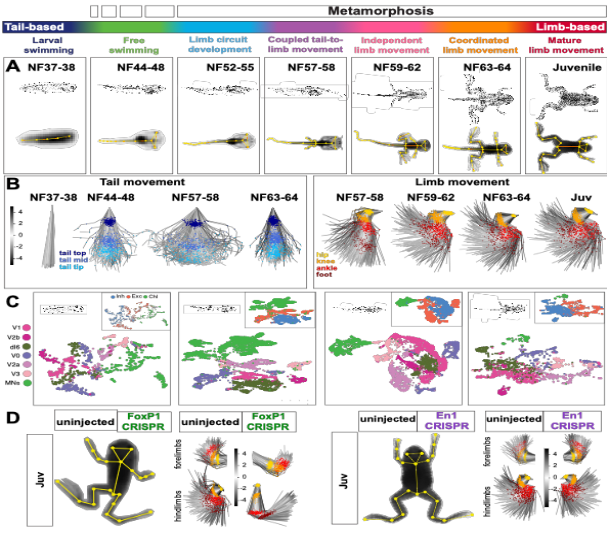
As vertebrates transitioned from water to land, their movement shifted from undulatory swimming to limb-based locomotion. How spinal circuits and their cell types evolved to support this transition remains unclear. In our recent Cell Reports paper, we pioneer frog metamorphosis to define aquatic versus terrestrial motor patterns. We develop a machine-learning based approach to quantitate this tail-to-limb motor transformation; utilize single-cell sequencing to characterize the corresponding cellular changes in the spinal cord; and employ one-sided, CRISPR mutation to manipulate gene expression and evaluate the effects on motor output. Comparative analyses across metamorphic stages reveal molecular segregation between swim- and limb-associated circuits, indicating progressive specialization of locomotor networks. In particular, the diversification and increased abundance of inhibitory interneuron populations plays a key role in the transition from tail-driven swimming to coordinated limb-based locomotion. Together, these findings provide a first cellular and molecular framework for understanding spinal circuit adaptation during vertebrate evolution and the emergence of terrestrial motor control.