
November 25, 2026
Coffee, Geometry & a Barcode
ISTA mathematician develops new tool to track changing geometry
A conversation over coffee with postdoc Michał Lipiński at the Institute of Science and Technology Austria (ISTA) turns into a journey of mathematical discovery that highlights the power of partnership and persistence. In what could be a film script spanning countries, time, and handwritten notes, the researcher recounts how he and his collaborators connected three areas of mathematics to capture a system’s evolving geometry in a barcode. Their ingenious approach could one day lead to new tools to analyze complex data sets.
You arrive a few minutes early to a meeting at the Error Bar—the aptly named eatery in the heart of the ISTA campus. Today, you’ll be talking to Michał Lipiński, an IST-BRIDGE Fellow in the Edelsbrunner group. He is eager to tell you about his recent work on how geometry changes over time.
Tick-tock. Tick-tock. The pendulum clock’s steady ticking rises above the restaurant chatter.
From a pendulum’s swing and water flowing through pipes to the planets’ orbits around the Sun, we are surrounded by complex systems that evolve over time. Mathematicians describe and study these evolving motions as dynamical systems. Dynamical-systems methods, often expressed through differential equations, help researchers study processes such as the spread of disease, fluid dynamics, ecological balance, and how materials behave. They may also help scientists study challenges in climate modeling, epidemiology, and systems biology.
But one important question remains: how does the geometry of a dynamical system change over time?
Lipiński arrives, and you both order coffee while he reviews his notes on a tablet.

The quest for geometric ‘truth’
Understanding a dynamical system’s structure can help mathematicians characterize its long-term behavior, thereby enabling applications ranging from self-assembly and self-organization to chaos theory. Such an approach focuses on the system’s topology, that is, its properties that are preserved under continuous deformation, like the type and number of holes. To do so, they analyze the connections between “invariant sets” that remain unchanged under the system’s dynamics. Using a tool called persistent homology, mathematicians can distinguish ‘real’, meaningful structures in data from noise. “Here, ‘real’ refers to mathematical features that persist despite noise, which means we can consider them to be ‘true,’” Lipiński explains.
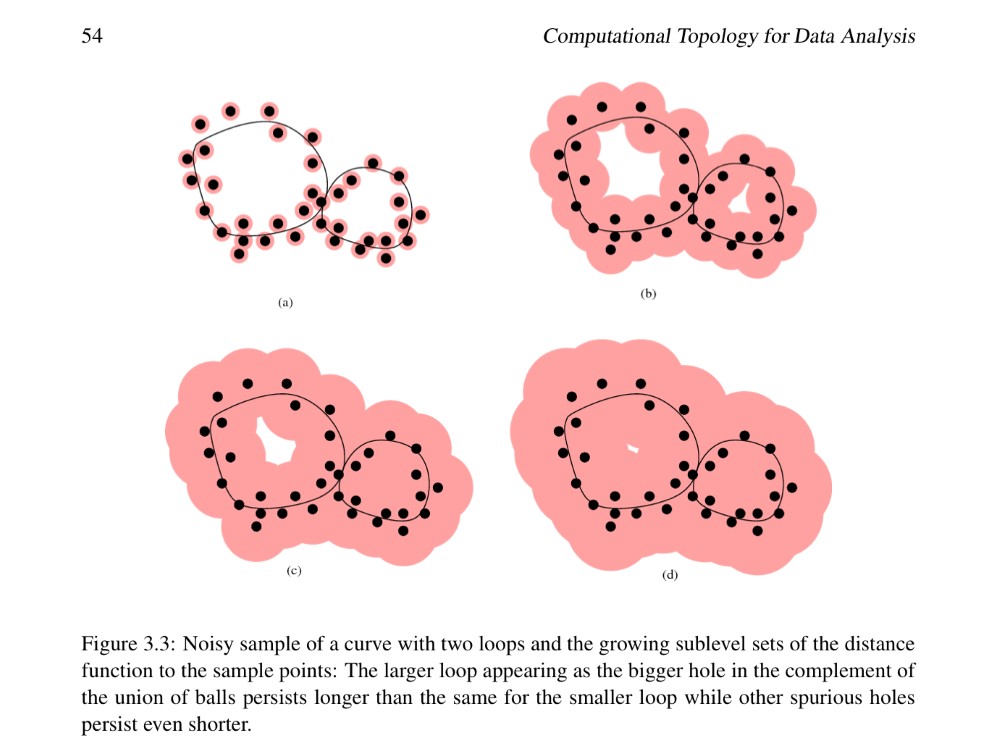
Let’s suppose that a laboratory scientist thinks that their data points form a shape like the numeral 8. To demonstrate this, they can gradually enlarge the points by the same amount until they touch, revealing the two holes in the shape of an 8.
“Persistent homology is a set of tools for identifying qualitative features in data,” Lipiński says.
By applying topological methods to data analysis, persistent homology gave rise to the mathematical area of topological data analysis (TDA).
Close parallels, unclear connections
TDA is a relatively young field that ISTA Professor Herbert Edelsbrunner helped establish. Dynamical-systems theory, by contrast, has a longer history.
Meanwhile, other areas of mathematics have progressed in parallel, such as the Conley index theory, in which researchers use vector fields—arrows indicating the direction of motion at each point—to describe how systems evolve over time. Conley index theory draws on algebraic topology, a branch of mathematics that uses tools from abstract algebra to study topological spaces. It provides a mathematical signature that could complement persistent homology’s tools.
Persistent homology and Conley index theory developed largely separately. However, they use similar tools.
“Parallels exist, but the relation between them has remained unclear for a long time,” says Lipiński.
He has been working to uncover and strengthen these connections since he was a graduate student.
“The intuition was there from the start, but I hadn’t yet worked out how to formalize it,” he explains.

Perfect trio
Lipiński and other researchers have long tried to connect TDA with Conley index theory.
“I already attempted to bridge the two areas in my PhD thesis, working in a field called combinatorial dynamics,” says Lipiński. “But looking back, my work then seems rudimentary to me now. Nonetheless, these preliminary steps helped us develop the intuition needed for this project.”
Shortly after Lipiński joined the Edelsbrunner group as an IST-BRIDGE Fellow, he and ISTA alum Manuel Soriano-Trigueros—now a tenure-track faculty member at Universidad de Sevilla, Spain—both visited Edelsbrunner during his sabbatical in Japan. That visit led them to discuss the project.
Lipiński also visited Tamal Dey, a professor at Purdue University in the United States, to discuss a possible collaboration and attempt to formalize the idea. He has even kept the notes from that two-week February 2022 trip.
“The hardest part of a mathematical collaboration is explaining an initial idea clearly, translating it between technical fields, showing potential collaborators how their expertise could help develop the idea, and convincing them that the project is worth pursuing,” explains Lipiński.
“This illustrates the importance of collaboration. Tamal, Manuel, and I made the perfect trio to tackle this problem.”
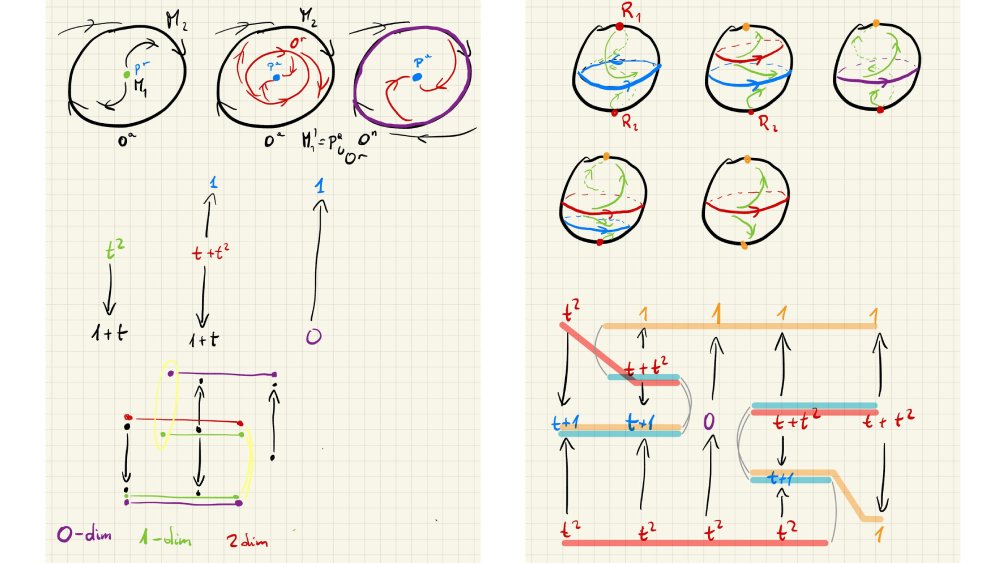
While Lipiński wrote the initial application for his IST-BRIDGE fellowship, Soriano-Trigueros contributed expertise in the algebraic aspects of persistent homology, and Dey helped develop algorithms for persistent homology.
Clearly, a bridge needed to be built, but before the team could connect the fields, they had to clarify how the pieces fit together.
One bridge, three shores
The three mathematicians developed and tested the theory. As their collaboration progressed, it became increasingly clear they were connecting not two fields, but three.
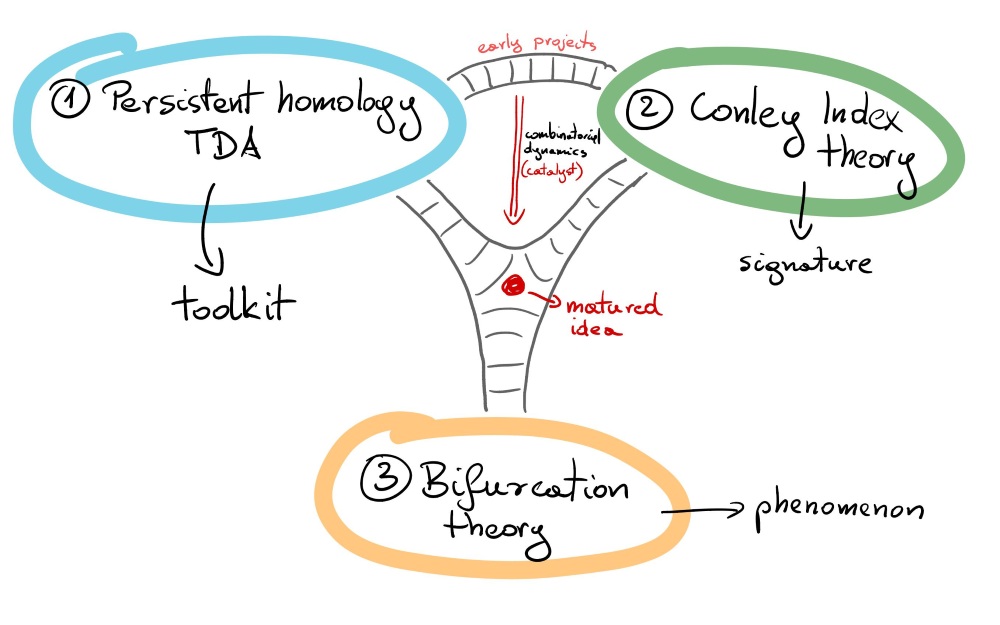
“My initial work in combinatorial dynamics catalyzed a more mature idea,” says Lipiński. “Instead of only bridging persistent homology in TDA with Conley index theory, the project connected both fields to bifurcation theory.”
A bifurcation is a key concept in dynamical systems theory. It occurs when a small change in a parameter causes a substantial change in a system’s structure, resulting in a qualitative change in its behavior.
“Persistent homology provided the tools, Conley index theory the signature, and bifurcation theory a way to describe the phenomenon mathematically,” Lipiński says. “Bridging these three areas made the theory come together nicely.”
A barcode is born
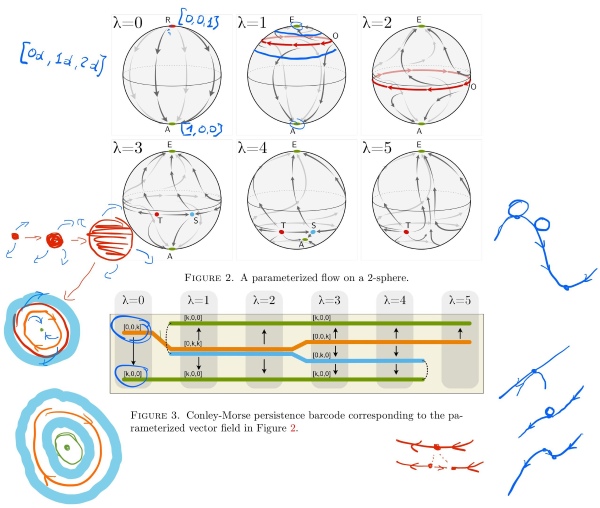
To visualize their combined theory, the researchers introduced a Conley–Morse persistence barcode—a concise representation of how certain features appear and disappear as a system changes.
“The barcode is a compact summary of the dynamical evolution of a system,” Lipiński explains. “Just by looking at the barcode, one can understand key aspects of the dynamical evolution of the entire system.”
Their joint paper about the barcode was published earlier this year in Foundations of Computational Mathematics, a leading journal in the field.
The question with which it all began, however, dates back almost a decade and a half to 2012. That’s when Lipiński’s PhD supervisor, Marian Mrozek, a professor at Jagiellonian University in Poland, raised it.
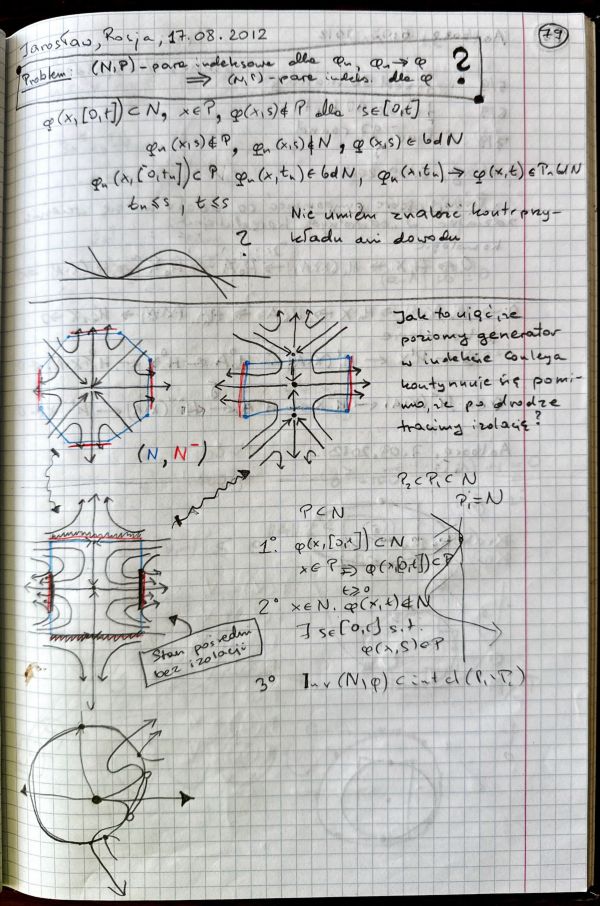
At a conference in Yaroslavl, Russia, that same year, which both he and Edelsbrunner attended, Mrozek tried to convince Edelsbrunner that the Conley index theory and persistent homology were likely closely related and that this connection would make it possible to track how the Conley index changes over time. Mrozek carefully kept the notes he wrote in Polish at the conference and later shared them with Lipiński.
Toward applications in data science
The new barcode has allowed Lipiński and the team to gain fresh insight into the evolution of dynamical systems. One finding is that they now have the certainty that each newly appearing feature is paired with a complementary feature. “In addition to being born in pairs, features also disappear in pairs,” says Lipiński. “If you want to ‘kill’ an element of a Conley index, you must kill a complementary one with it.”
The framework may reveal further mathematical properties of the system. Its combinatorial nature could also make it applicable to problems in data science. “This work could help researchers apply dynamical-systems ideas to data science, such as Arctic atmospheric flow—that is, the movement of air masses around the polar region,” Lipiński says.
“The patterns of this movement change from season to season and from year to year. I hope that in the not-too-distant future our methods will be able to describe phenomena of this kind.”

How a mathematician’s mind ticks
Lipiński is a strong advocate of working through mathematics with pen and paper—or a tablet, for that matter. Solving problems in writing helps him see how fully formed his ideas are.
“I also like to work somewhere quiet, away from distractions,” he says. “Some of my best ideas come at unexpected moments. It is not uncommon for me to wake up, say, at four in the morning thinking about math and coming up with new ideas.”
Looking back, he did not expect the project to unfold so smoothly.
“I expected to fall into multiparameter persistence—a technically challenging, and frankly, quite messy area. But things went much more smoothly than I expected,” he says with a grin of satisfaction.
Today, Lipiński is proud of his and his collaborators’ achievement.
“This is my first major project of my own, with help from Tamal and Manuel, and it seems we’ve been able to find a new connection between different fields of mathematics,” he says.
Now, he is exploring how the three fields might fit together in a more unified framework, both theoretically and computationally.

“Generally, an abstract theory can be translated visually into a geometric representation, and visual representations can help people understand abstract ideas,” Lipiński says while taking his last sip of coffee.
“Today, AI-generated proofs are reshaping mathematics. However, mathematicians will still invest considerable effort into understanding mathematical concepts. We may not be able to match machines in every respect, but I hope approaches such as geometric visualization will continue to help us make sense of complexity.”
After a pause, Lipiński turns to the longstanding debate over whether mathematics is discovered or invented.
“Discovery plays a major role in our field. But to make a discovery visible and accessible, we sometimes need to build an initial scaffold—such as a theory that becomes more elegant over time,” he says.
“Does this mean there are no more worlds to conquer in mathematics? Not at all. I’m curious to see how the field will continue to develop in the age of AI.”
Publication:
Dey, T.K., Lipiński, M. & Soriano-Trigueros, M. 2026. Conley–Morse Persistence Barcode: A Homological Signature of Combinatorial Bifurcations. Foundations of Computational Mathematics. DOI: 10.1007/s10208-026-09766-6
Funding information:
This project was supported by funding from the European Union’s Horizon 2020 research and innovation program under the Marie Skłodowska-Curie Grant Agreement No. 101034413 and U.S. National Science Foundation (NSF) funds CCF-2437030 and DMS-2301360.


