June 30, 2026
Harnessing Light at the Nanoscale
Physicist and engineer Charles Roques-Carmes joins the ISTA faculty
How do light particles behave when confined to a few billionths of a meter? And how can these phenomena drive discoveries in imaging, communication, and quantum technologies? Charles Roques-Carmes, who joined the Institute of Science and Technology Austria (ISTA) as an assistant professor in June, will investigate these questions together with his research group. By bridging physics and engineering, Roques-Carmes aims to transform fundamental insights about light into tools that advance technology and benefit society.

Light surrounds us and shapes our lives in ways we might not even imagine. But how well do we understand this vital form of radiation?
The Roques-Carmes group at the Institute of Science and Technology Austria (ISTA) studies how light behaves at extremely small scales and how those effects can be harnessed to develop new scientific and technological tools. This research field is called nanophotonics or nano-optics—the study of the behavior of light on the nanometer scale and its interaction with materials measured in billionths of a meter.
When light particles, or photons, are confined to the nanoscale—where quantum‑optical interactions dominate—new light behaviors emerge. By probing these hidden regimes of light behavior, Charles Roques-Carmes and his group aim to achieve better control of light and harness interactions between light and matter that arise only at the nanoscale. Ultimately, this knowledge will allow scientists to transform areas such as advanced microscopy, sensing, communication, quantum technologies, and medical imaging.
Accelerating the path from theory to application
With his team, Roques-Carmes hopes to turn fundamental insights about light into practical tools to help us observe, measure, and process information in new ways. One concrete example is his work on developing a class of materials called nanophotonic scintillators. These engineered materials are structured at the nanoscale to convert X-rays into visible light more efficiently, ultimately improving medical imaging, microscopy, and radiation detection. “More broadly, I hope our work helps accelerate the path from theoretical ideas to real-world technologies,” he says.
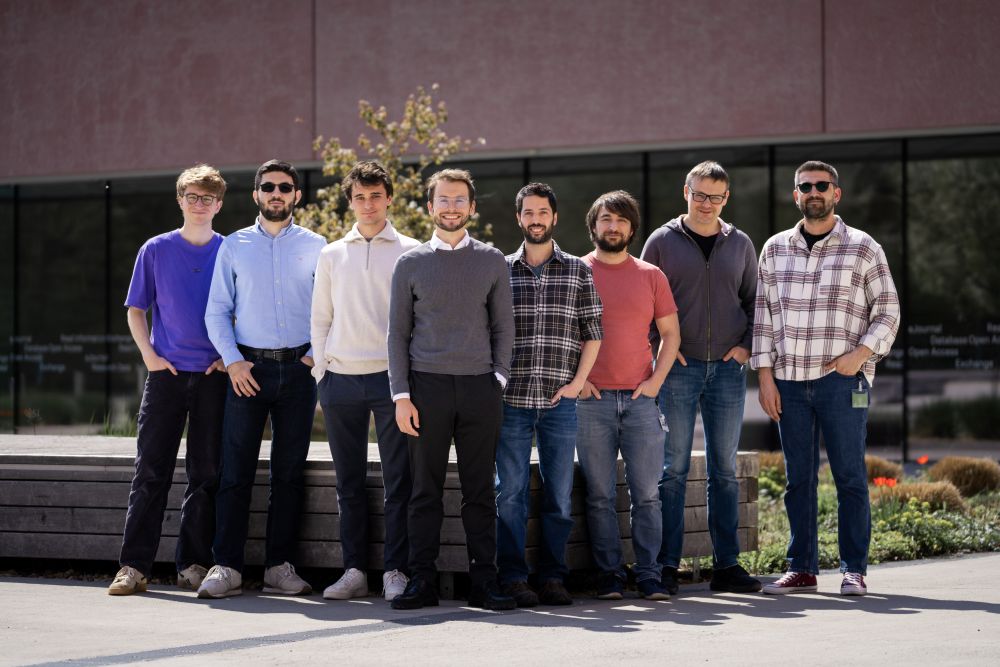
His group is driven by questions at the interface of physics and engineering, including the nanoscale control of light, microscopy, imaging, and quantum technologies. “Within the next five years, I hope we can solve one or two of these questions, or at least learn something unexpected and important along the way—but most importantly, have fun doing it!”
In addition to fundamental research in nanophotonics and applications in healthcare and imaging, the Roques-Carmes group’s projects encompass next-generation communication and computation techniques powered by reconfigurable photonic circuits. This approach will enable the design of devices capable of learning, sensing, and processing information optically—contributing to future optical AI technologies.
A place for innovative ideas and mentorship
For Roques-Carmes, research and technology go hand in hand. He hopes his group will serve as an incubator for innovative ideas and contribute to technology transfer within ISTA and its tech transfer hub, XISTA. “Europe has extraordinary scientific strength, and one of the next challenges is to build stronger bridges between academic discoveries and technologies that can have a broad and strategic impact,” he underlines.

Beyond his scientific curiosity and drive for innovation, Roques‑Carmes emphasizes the human element behind technological ambition. He hopes to attract and mentor his first cohort of creative, independent scientists who will make significant contributions to academia, industry, or policy. “I would like them to leave the group not only with strong scientific training, but also with the ambition to address major societal challenges in areas such as energy, computing, imaging, communication, and health,” he explains.
Balancing career, recognition, and life beyond the lab
Originally from France, Roques-Carmes completed his bachelor’s in engineering and master’s in physics at the École Polytechnique in Palaiseau, France, before obtaining his PhD in Electrical Engineering and Computer Science at the Massachusetts Institute of Technology (MIT) in the United States in 2022. He continued his research as a postdoctoral Science Fellow at Stanford University before establishing his group at ISTA.
International recognition has accompanied Roques-Carmes throughout his early career. He was named to Forbes’ 30 Under 30 (Science, 2023), received the Stanford Science Fellowship the same year, and was the inaugural recipient of the Photonics Innovation Award of the Nanophotonics journal in honor of its founding editor, Federico Capasso (2025).
Outside the laboratory, Roques-Carmes balances intensity with reflection. He finds restoration in endurance running, scuba diving, hiking, and cooking large meals for friends. He also reads and writes extensively and enjoys thinking about language and speech, especially through poetry and novels. “Recently, I have been getting stuck on questions about what it means to write in the age of AI, and how new technologies may change not only how we work, but also how we express ourselves.” As Roques‑Carmes begins his faculty appointment at ISTA, he joins the institute’s interdisciplinary community to explore innovative ideas at the intersection of physics and engineering, with a focus on real‑world applications.