
November 18, 2026
How Genes Dictate Brain Size
ISTA scientists show what happens when the growth brake fails
The gene Pten acts like a molecular brake. It helps maintain balance during brain development, when specific progenitor cells must be present at the right time, the right place, and in the right numbers. In Science Advances, the Hippenmeyer group at the Institute of Science and Technology Austria (ISTA) now reveals the domino effect that occurs when this brake is missing in even just individual progenitor cells.
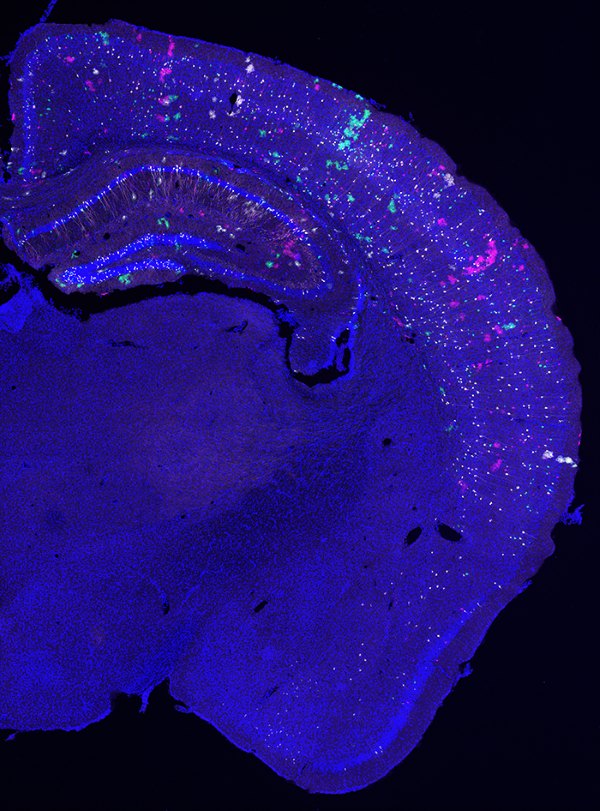
The brain is one of the most complex organs in the body, and, across populations, its size is relatively similar. In rare cases, genetic mutations can lead to an overgrowth of the brain.
The medical term megalencephaly describes an unusually large brain size. It is a statistical measurement and does not necessarily indicate disease. Mutations to Pten, a gene critical for hitting the brakes on cell divisions, are often associated with megalencephaly and an increased risk of tumor development.
The Hippenmeyer group at the Institute of Science and Technology Austria (ISTA), in collaboration with researchers at Sorbonne Université in Paris, Yale School of Medicine in the United States, and Vetmeduni Vienna, now provides detailed insights into how loss of PTEN affects brain development in mice.
The researchers followed individual progenitor cells and their descendants. When PTEN is absent during the development of the cerebral cortex—the outermost layer of the brain—these progenitors produce too many nerve cells (neurons).
Critically, they show, for the first time, that those same progenitors also make more astrocytes—the brain’s supporting cells. This excess cell production is likely a driver of megalencephaly. The team also identified molecular signaling pathways through which PTEN influences these developmental processes.
The starting point
“People with mutations in PTEN often have megalencephaly and an increased risk of developing tumors,” explains Osvaldo Miranda Romero, first author of the study and a postdoctoral researcher in the Hippenmeyer group. “They are also more likely to be on the autism spectrum, have intellectual disabilities, or experience epilepsy.”
These conditions are collectively referred to as PTEN Hamartoma Tumor Syndrome.

Earlier studies in mice showed that embryos die when Pten is switched off in the developing organism. In contrast, when the gene is selectively inactivated only in the brain or cerebral cortex, megalencephaly develops, but those mice die shortly after birth.
“Until now, we lacked basic information about what Pten mutations mean at the level of individual cells and how they affect cellular output—in other words, the quantity and identity of cells produced from stem cells,” explains Romero.
No PTEN means more—and larger—brain cells
Using MADM technology, Romero was able to investigate this question. The researchers selectively switched off the Pten gene in a tiny fraction of radial glial cells. They labeled the affected cells with fluorescent markers and followed them throughout development. This method is known as lineage tracing—in simple terms, it creates a ‘cellular family tree.’
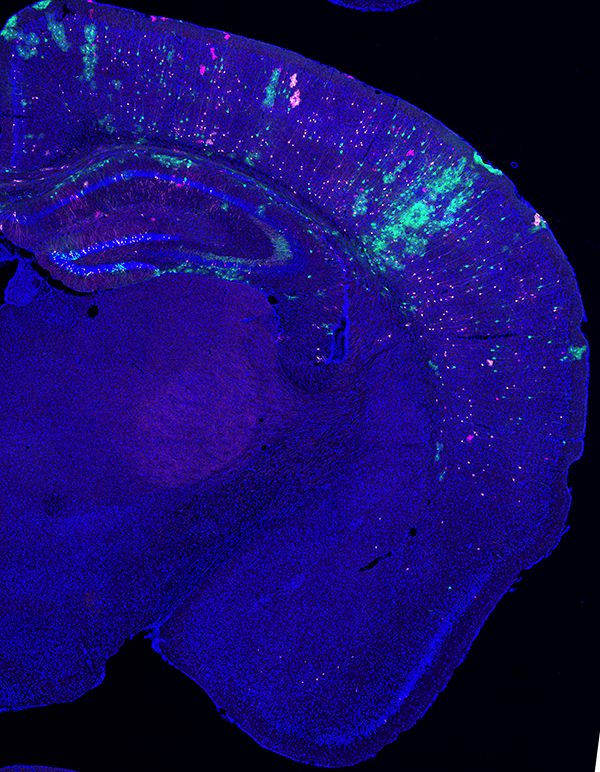
Radial glial cells are progenitor cells of the cerebral cortex. They first multiply and then produce neurons. At a later stage, they can also give rise to glial cells—the brain’s supporting cells. Both cell types are essential for the proper development and organization of the cerebral cortex.
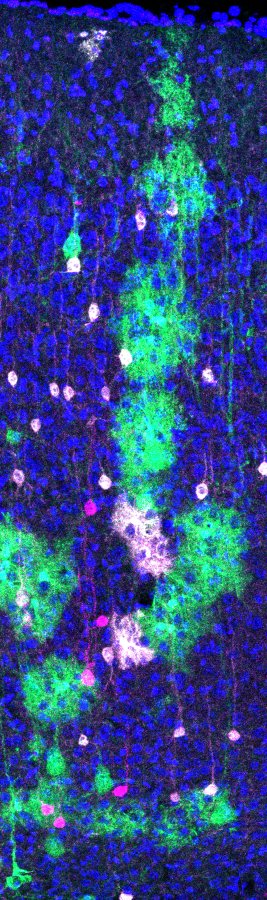
The analysis showed that individual radial glial cells lacking Pten produce around 25% more neurons than under normal developmental conditions. They also generate substantially more astrocytes—a specific type of glial cell. These neurons and astrocytes are enlarged as well. This combination of more—and larger—brain cells could help explain PTEN-associated megalencephaly.
Alternative signaling route
“The transition from radial glial cells to astrocytes is particularly exciting,” says Romero.
Cells need to send and receive information and instructions about what they should do. They accomplish this through cellular signaling pathways, which can be thought of as established communication lines with specific functions. Under normal conditions, radial glial cells rely on signals from the EGFR signaling pathway to produce glial cells—particularly astrocytes.
In further experiments, the researchers selectively switched off both Pten and Egfr in radial glial cells. They found that the cells no longer relied on the usual EGFR communication route. Instead, signaling shifted toward the MAPK pathway in Pten mutants.

“Under normal conditions, EGFR is an important driver of glial-cell formation, whereas MAPK can serve as a kind of alternative route under exceptional circumstances,” explains Romero.
People with PTEN mutations can develop gliomas—brain tumors made up of astrocytes and other glial cells. These tumors are often treated with EGFR inhibitors, but some patients develop resistance to these drugs.
“Our findings suggest that the MAPK signaling pathway could be investigated as a potential therapeutic target in such cases in the future,” says Romero.
Pten – Mouse/rat gene
PTEN – Human gene
PTEN – Protein
In mice, the gene Pten and, in humans, the gene PTEN each encode the PTEN protein.
Publication:
Miranda et al. 2026. Pten Regulates Neurogenic Radial Glia Lineage Progression and Tunes Neocortical Astrocyte Production in Mapk1/3-dependent Pathway. Science Advances. DOI: 10.1126/sciadv.aeh1717
Funding information:
This project was supported by funding from the Austrian Academy of Sciences DOC Fellowship DOC186584, the Austrian Science Fund FWF Elise Richter Program V1041T, the Austrian Science Fund FWF SFB Neuro Stem Modulation F87, the European Research Council EU Horizon 2020 725780 LinPro, and ISTA Institutional Funds.
Information on animal studies:
In order to better understand fundamental processes, for example, in the fields of neuroscience, immunology, or genetics, the use of animals in research is indispensable. No other methods, such as in silico models, can serve as an alternative. The animals are raised, kept, and treated according to the strict regulations of Austrian law. All animal procedures are approved by the Austrian Federal Ministry of Women, Science, and Research.


