
September 10, 2026
Three Mathematicians Join ISTA Faculty
New faculty members will study primes, waves, and discrete systems
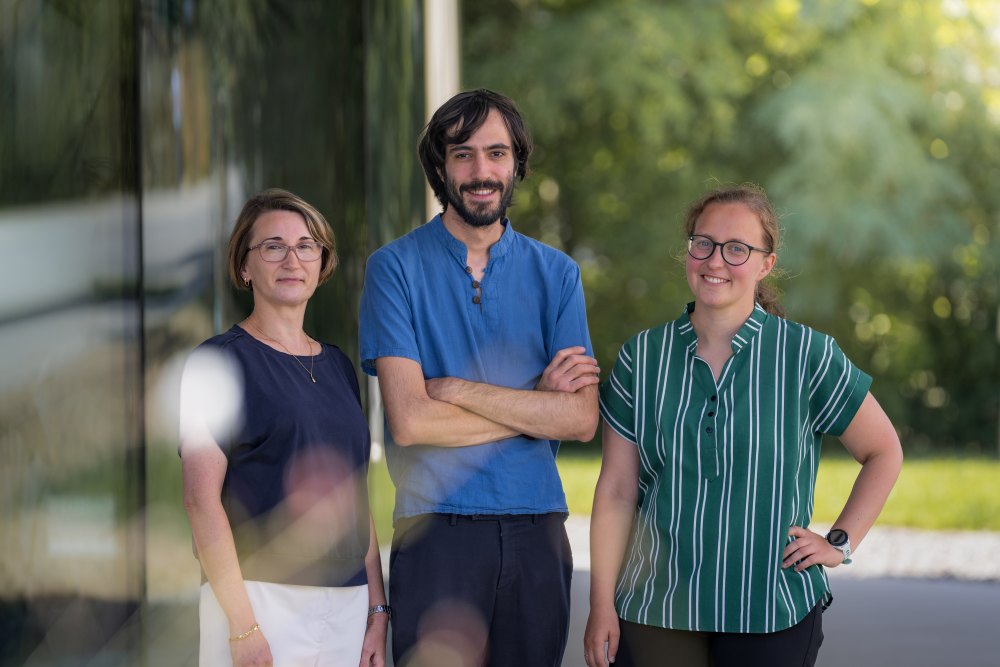
This September, Monica Vișan joins the Institute of Science and Technology Austria (ISTA) as Professor and Vivian Kuperberg and Yuval Wigderson join as Assistant Professors. Their research ranges from the apparent randomness of primes to wave propagation and the structure of discrete systems. Each will pursue fundamental questions through connections across mathematical fields and will contribute to the Institute’s interdisciplinarity and diversity. Join us in welcoming Kuperberg, Vișan, and Wigderson to ISTA.
Vivian Kuperberg: Primes, Polynomials, and Patterns
Kuperberg studies arithmetic sequences, especially prime numbers: natural numbers that cannot be expressed as a product of two smaller numbers. While these objects are defined by precise rules and are used throughout number theory and in applications such as encryption systems, their distribution nevertheless often appears random. Kuperberg’s group will use analytic, probabilistic, and combinatorial methods, alongside sieve methods and tools from additive combinatorics and algebraic geometry, to investigate where this apparent randomness holds.
“My research group aims to understand the ways in which arithmetic sequences, such as the prime numbers, behave ‘randomly,’ and the ways in which they don’t,” she says. A particular focus will be on consecutive primes, including what can be said about the next prime in increasing order after a given one and how large gaps between consecutive primes can be.
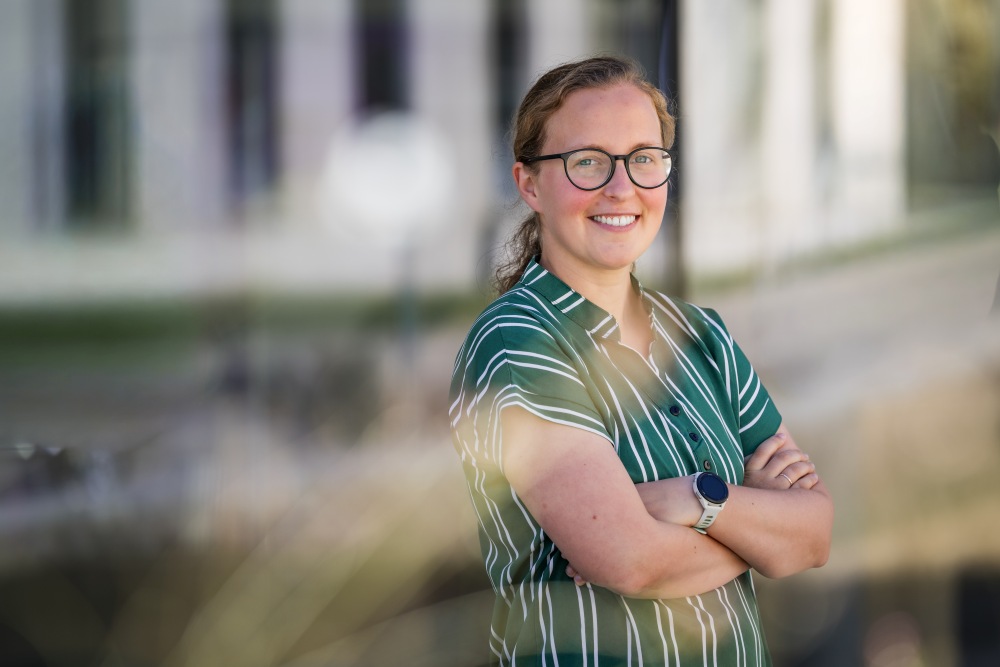
Originally from the United States, Kuperberg received her PhD from Stanford University in 2022. Before joining ISTA, she was a Hermann Weyl Instructor at ETH Zurich, Switzerland, from 2023 to 2026, after a postdoc at Tel Aviv University, Israel, as a National Science Foundation (NSF) Postdoctoral Scholar. Her distinctions include the NSF Mathematical Sciences Postdoctoral Research Fellowship, held from 2022 to 2024, and Stanford University’s 2022 Pólya Teaching Fellow Award.
During her first five years at ISTA, Kuperberg plans to investigate average upper bounds for correlations between prime numbers and the angle distribution of polynomials. Her research will also consider sequences such as sums of two squares and analogues of primes, including irreducible polynomials in polynomial rings. In her free time, she enjoys hiking, running, reading, and crossword puzzles.
Monica Vișan: The Long-Term Motion of Waves
Vișan’s group investigates nonlinear dispersive partial differential equations. An example of dispersion is the splitting of light in a prism; this is due to the fact that different colors of light travel with different speeds in glass. Dispersion tends to split waves apart, while nonlinearities may draw them together creating an intense focusing of energy. Throughout her career, Vișan has analyzed the competition between these two effects, not only in optics, but also in models arising from Bose-Einstein condensates and fluid dynamics.
“For many models of wave propagation, long-time behavior is well understood when initial excitations are localized,” Vișan explains. “I aim to understand what happens when the initial wave is scattered throughout space, leading to constant self-interaction—a physically vital question that remains a mathematical challenge.”
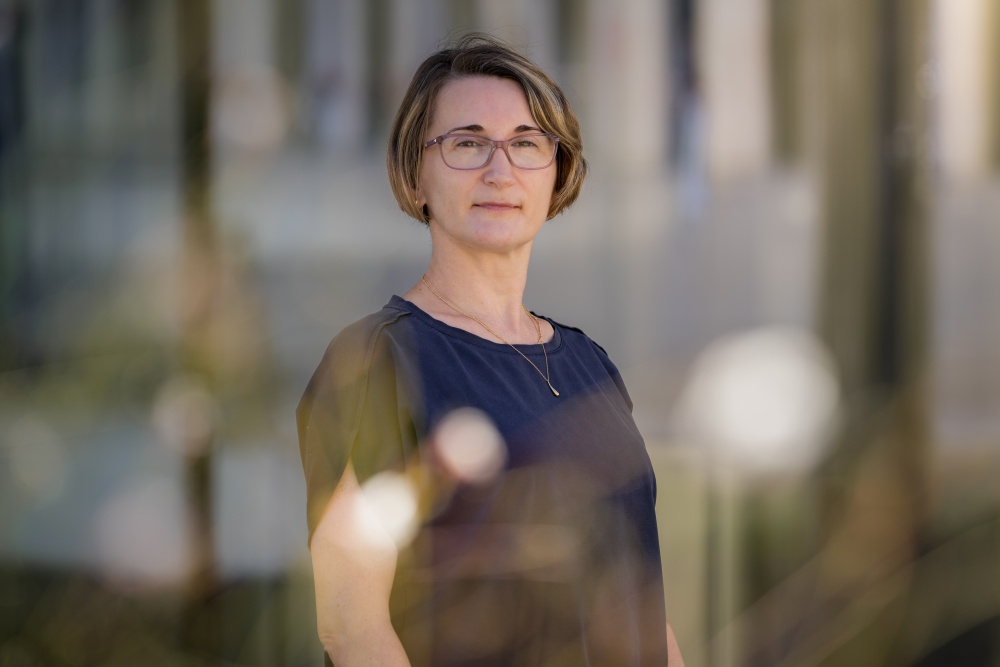
Following her undergraduate studies in her home country, Romania, Vișan received her PhD from the University of California, Los Angeles (UCLA), in 2006. Before joining ISTA, Vișan was a long-standing faculty member at UCLA since 2009, becoming a full professor in 2014. Among her illustrious career’s many distinctions are the inaugural Edmond and Nancy Tomastik Prize in Differential Equations in 2026, presented by the American Mathematical Society, the 2026 Emmy Noether Lectureship, awarded by the Association for Women in Mathematics and the American Mathematical Society, and the 2026 Uhlenbeck Lectureship at the Institute for Advanced Studies’ Women and Mathematics (WAM) Program. She was a Simons Fellow in Mathematics in 2024–2025 and was elected a Fellow of the American Mathematical Society in 2024.
Her group will also work on the topics of scattering, dynamics for wave systems in thermal equilibrium, as well as continuum limits of particle systems. Vișan hopes the group will become a hub for training, research, and collaboration on wave motion, engaging with other groups at ISTA and internationally. In her free time, she hikes with her family, travels, reads, listens to music, and watches movies.
Yuval Wigderson: Order and Chaos in Discrete Systems
Wigderson works in extremal combinatorics and Ramsey theory, fields concerned with the size and structure of discrete objects—meaning separate, distinct, and countable items—under natural constraints. These objects can include graphs, sets of integers, collections of points and lines, and spaces of matrices. Questions in the field often ask how large such objects can be while avoiding a specified structure—for instance, a cycle of a given length in a graph.
“A remarkable and deep phenomenon that occurs throughout mathematics is that ‘complete disorder is impossible.’ Any sufficiently large system, no matter how chaotic it may seem, must contain a highly structured portion,” Wigderson says.
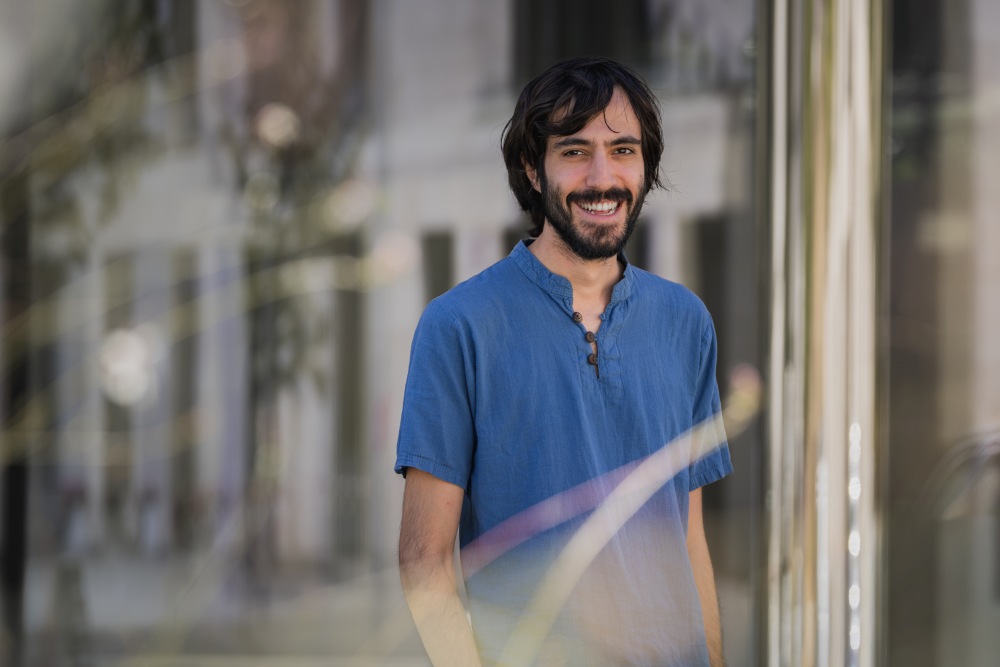
Wigderson, who comes from the United States, received his PhD from Stanford University in 2022. Before joining ISTA, he was a Junior Fellow at the Institute for Theoretical Studies at ETH Zurich, Switzerland, from 2023 to 2026. His distinctions include a Junior Fellowship at ETH Zurich’s Institute for Theoretical Studies, an NSF Graduate Research Fellowship in Israel, and Stanford University’s 2022 Pólya Teaching Fellow Award.
His group will study the trade-offs between order and chaos through Ramsey theory, extremal graph theory, random and pseudorandom graphs, hypergraph regularity, matrix spaces, and directed graphs. Wigderson plans to work with his group on learning recently introduced techniques that have helped resolve long-standing open problems and on exploring further applications for them. He enjoys reading fiction and discovering unfamiliar authors, hiking most weekends, cooking, as well as “trying to make the perfect cappuccino.”