December 9, 2025
Two ERC Consolidator Grants
4 million Euro boosting theoretical quantum physics and biophysics
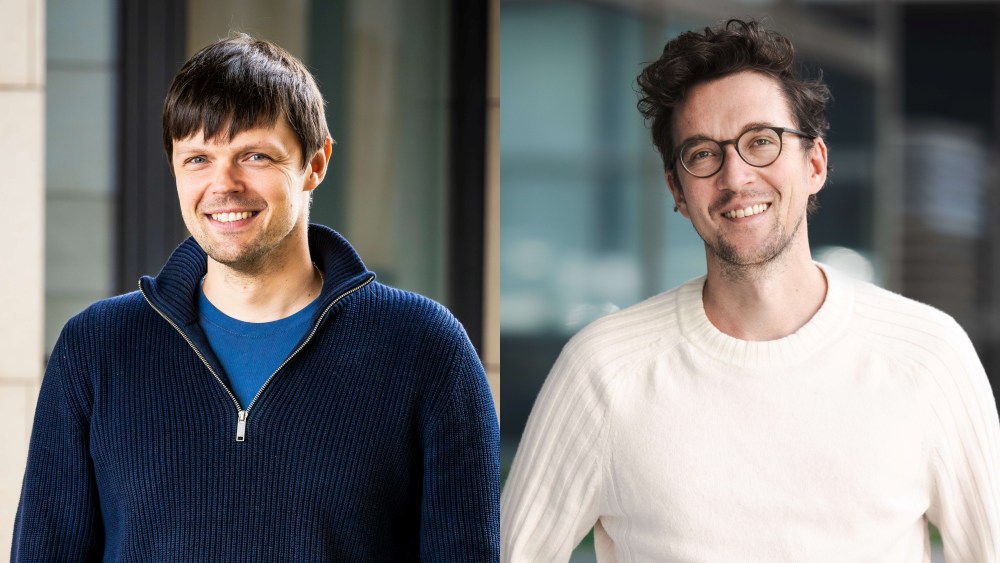
Two professors at the Institute of Science and Technology Austria (ISTA) have been awarded European Research Council (ERC) consolidator grants of two million Euro each. Both trained physicists, their fields of research could hardly be more different: Edouard Hannezo combines physics with data science and cell biology to investigate how organisms form body structures reliably in the process of development; and Maksym Serbyn develops theoretical frameworks to describe the complexity of many-body quantum phenomena.
The consolidator grant scheme of the European Research Council (ERC) funds “emerging research leaders” with two million Euro over a period of five years. With this double success in the most recent funding round, ISTA group leaders have secured nine ERC grants in 2025, of which eight are the prestigious ERC frontier grants. This brings the total number of ERC grants ever awarded to faculty members at ISTA to 96 – including those transferred to ISTA and proof-of-concept grants. With currently 86 research groups at ISTA, it underlines the Institute’s top success rate in this funding scheme.
REFINE: Interdisciplinary approach to morphogenesis
When organisms develop their bodies, they maintain astonishing consistency in shape, despite the fact that recent research has uncovered high randomness at the molecular and cellular level. Previous research has often neglected this background noise, not answering the question of what ensures the reliable growth of tissue. Professor Edouard Hannezo and his team at ISTA tackle this mystery of life with a diverse toolbox from data science, cell biology, and physics.

“Our studies seek to reveal fundamental principles of biological design”, says Hannezo. “In the REFINE project, we will work on theoretical models to study the interactions between cell forces, biological signals, and the geometrical constrains of embryo development. Afterwards, we test these ideas in experiments with our collaborators, where we adjust conditions to understand how randomness can disrupt or actually support embryo growth. The ERC grant will help us to understand how life develops robustly.”
QMbeyondU: Quantum matter beyond unitary dynamics
Quantum physics is hard to simulate, especially for many-body systems with many interacting particles. In isolation, such systems evolve reversibly under “unitary” dynamics which can generate uniquely quantum correlations called entanglement. In real devices, however, they are affected by noise, dissipation, and measurements, which are described by fundamentally different, non-unitary dynamics. Most existing approaches either treat these effects as imperfections to be minimized, or model the resulting dynamics as effectively classical. With this ERC grant, Professor Maksym Serbyn aims to uncover phenomena where the quantum nature and these non-unitary dynamics are both essential.
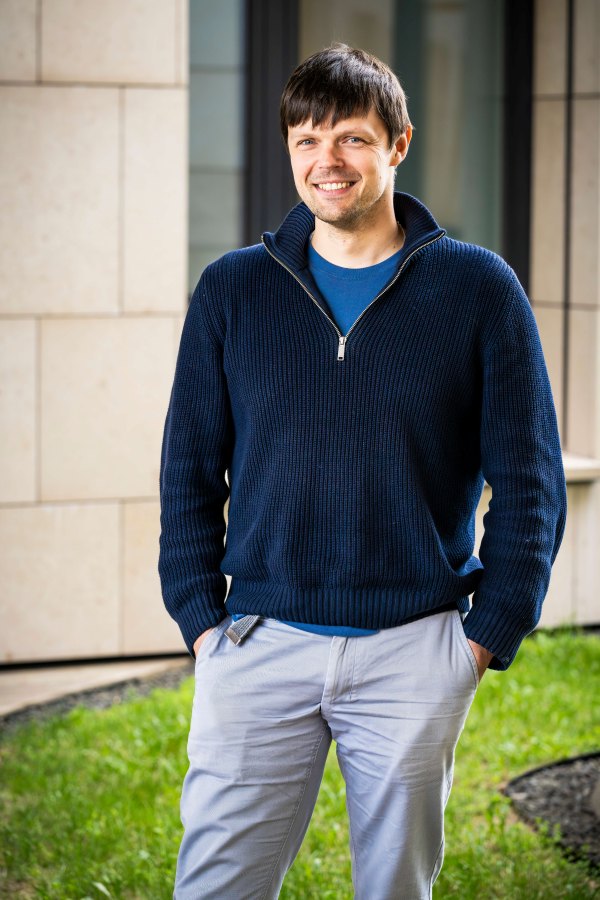
“The field of quantum simulation holds immense promise for exploring new physical phenomena,” says Serbyn, “but unlocking its full potential requires to use both unitary and non-unitary dynamics as resources. This is the goal of the QMbeyondU grant. If successful, it will reveal new quantum phenomena and improve our capabilities of controlling interacting quantum systems.”