
July 15, 2026
Quantum Effects Turn a Single Molecule into a Magnet
ISTA researchers uncover a quantum phenomenon relevant for nanodevices
Driving an electric current through a molecule can create a magnetic field. Yet in practice, such fields are often too weak to be detected experimentally. Through theoretical modeling, researchers at the Institute of Science and Technology Austria (ISTA) show how quantum effects can turn single molecules into effective magnets—including one shaped like a microscopic soccer ball, just in time for the FIFA World Cup final. The findings were published in Nature Communications.

Unlike fridge magnets, electromagnets are only magnetic when an electric current flows through them. This temporary—and therefore controllable—form of magnetism is essential in applications ranging from heavy-duty industrial cranes to electric motors, MRI machines, and other electronic devices.
At the nanoscale—a realm just billionths of a meter across—scientists can engineer single molecules to act as tiny electromagnets. While a technological breakthrough in this field could herald a new era in nanoelectronics, the magnetic fields generated in single‑molecule circuits are typically weak.
In a purely theoretical study, PhD student Wanzhuo Shi and Professor Latha Venkataraman at the Institute of Science and Technology Austria (ISTA) teamed up with international collaborators to uncover a physical phenomenon that could enable single molecules to behave as strong electromagnets. Their fully organic molecules feature circular or spherical shapes that amplify circulating electrical currents, thereby strengthening the predicted local magnetic fields above detection thresholds at this scale. The results could eventually be applied in the design of single-molecule nanodevices.

Overcoming challenges of molecular electronics
“How strong a magnetic field would it take to erase a hard drive?” Venkataraman asks Shi as they discuss their findings.
Far from trivial, this question underscores the scale difference between the magnetic fields used in everyday electronics and those achievable with single-molecule circuits.
“At least about 0.5 tesla,” Shi answers. Put into context, that’s roughly half the field strength used to lift a car in a junkyard.
“This seems like a lot compared to what our single-molecule electromagnets can achieve,” Venkataraman responds.
Fridge magnets, on the other hand, have a magnetic field of about five millitesla. To be experimentally relevant in nanoelectronics, single-molecule electromagnets must produce fields of comparable strength. Yet in most cases, the fields remain below detectable limits.
Eventually, it may be possible to write data on hard disks by passing a tiny current through a single molecule at a sensor tip. But before the technology is ready for industrial applications, can scientists engineer single molecules to act as sufficiently strong miniature magnets?
Unexplained measurements
Anyone can make an electromagnet at home with just a length of copper wire, a battery, and, optionally, an iron nail. By winding the copper wire into a coil and attaching each end to a battery terminal, the current flowing through it creates a magnetic field concentrated along the center of the coil. Winding the wire around the iron nail helps amplify the magnetic field.
At the nanoscale, the entire circuit is formed by attaching gold electrodes to a single organic molecule, composed entirely of carbon and hydrogen atoms. In a previous experimental study conducted at Columbia University before the Venkataraman group moved to ISTA, Shi measured the conductance of an organic ring-shaped molecule—a molecular loop known as a ‘nanohoop’. Conductance measures how easily electricity flows through a material or molecule. In these measurements, the presence or absence of the nanohoop in the molecular structure appeared to make a difference.
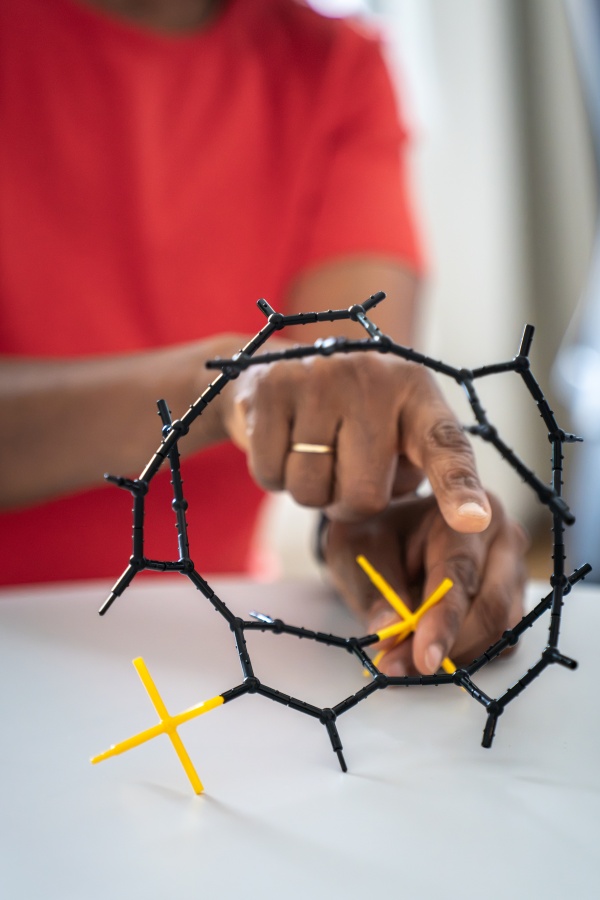
“After moving to ISTA, I started to think about the path taken by the current in these types of nanohoops,” says Shi. “A key question was whether any current would flow through the hoop or if all the current simply bypassed it and went just from one electrode to the other.”
This question is especially relevant because the resulting magnetic field would be proportional to the current circling the ring.
One quantum effect overrides another
To understand the paths taken by the electric current and how they impact the resulting magnetic field, Shi opted for a purely theoretical approach. He simplified the original ring‑and‑chain molecule, keeping only the nanohoop and a very short path between the gold electrodes. A simple toy model representing the structure would resemble a Ferris wheel standing on its electrodes.
Imagine many people lining up to ride an already full Ferris wheel, with each alighting passenger immediately replaced as the wheel spins.
“People getting on and off represent the current into and out of the electrodes, while riders on the wheel represent the larger current circling the nanohoop,” Venkataraman explains. People could either climb in and immediately get out, or climb in, go around the wheel, and then get out.
While the current flowing from one electrode to the next is limited by the “conductance quantum” at the nanoscale, the scientists realized that this limit did not apply to the current circling the nanohoop.
In their calculations, the team pinpointed another effect, called “quantum interference,” which can strongly amplify the circulating current in their single-molecule electromagnet. Since the molecular structure can assume several equal‑energy states called “degenerate resonances,” quantum interference near these states allows the current circling the ring to not only amplify considerably but also to reverse its direction.
In conventional electromagnets, the current direction is reversed by switching directions between the electrodes.
“We found that only the current in the nanohoop flips and amplifies, even though we don’t change the direction or strength of the current between the electrodes,” says Venkataraman. “Using quantum interference, we can tune the current inside the ring and control whether it flows clockwise or counter‑clockwise simply by tuning a gate voltage.”

A soccer ball, but make it nanoscale
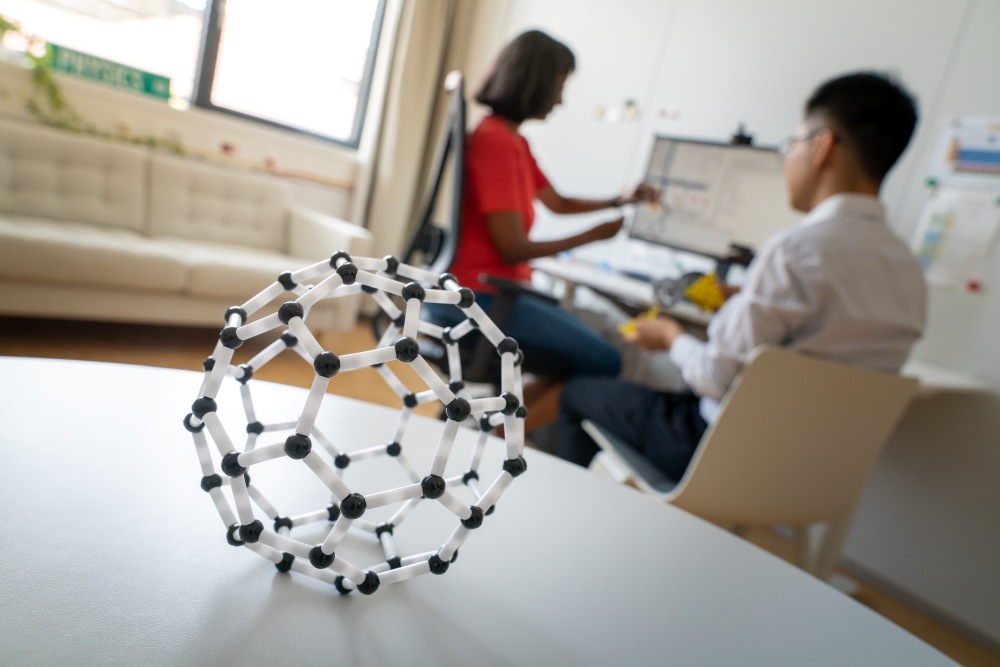
To better control on‑demand current flipping and amplification, the team turned to a spherical C60 buckminsterfullerene molecule—essentially a nano ‘soccer ball’—which makes it easier to boost the molecule’s magnetic field in experiments.
Placing the gold electrodes at specific locations on this nano ‘soccer ball’ allows the enhanced current to flow throughout the spherical structure, resulting in a magnetic field exceeding 14 millitesla at a source–drain voltage of only 100 millivolts. That’s almost three times the strength of a fridge magnet—concentrated in a single molecule.
“Our work provides design principles for turning a single molecule into an effective electromagnet by exploiting its structure and the relevant quantum effects,” says Shi.
With the FIFA World Cup final around the corner, could our everyday electronics one day feature a miniature soccer ball on a chip?
Publication:
Wanzhuo Shi, Richard Korytár, Ferdinand Evers, John D. Tovar, Latha Venkataraman. 2026. Designing Effective Single-Molecule Electromagnets with Radially π-Conjugated Carbon Structures. Nature Communications. DOI: 10.1038/s41467-026-74365-6
Funding information:
This work was supported by the National Science Foundation under grant NSF-DMR 2241180 and the Institute of Science and Technology Austria and was funded in part by the Austrian Science Fund (FWF) [10.55776/COE5] (Cluster of Excellence MECS). The collaboration between L.V., R.K., and F.E. was supported by the Humboldt Foundation.