
July 9, 2026
Roots Steer Clear of Plant Rot
Newly identified ‘saprotropism’ helps roots avoid decaying plant matter
Decaying matter shapes life in soil, but it can also create hostile zones for growing roots. Professor Jiří Friml of the Institute of Science and Technology Austria (ISTA) and international collaborators have now identified “saprotropism,” a root response that guides plants away from decaying plant-derived matter—but not animal-derived decay. The study, led by Yuzhou Zhang, Professor at Northwest A&F University in China and published in Science, reveals how roots adapt their growth direction by sensing local pH gradients around rot.
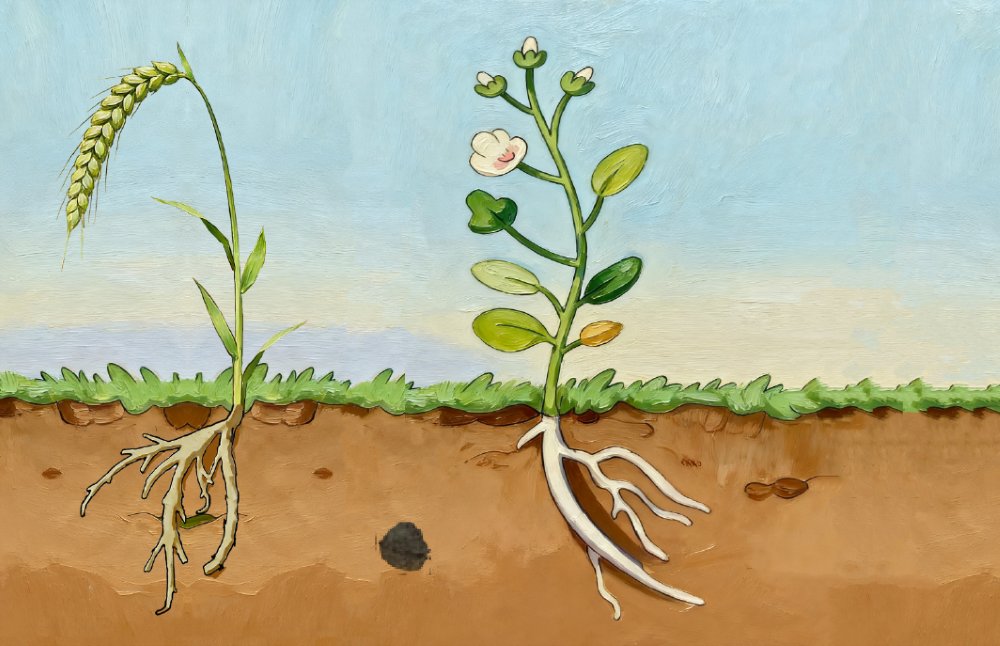
Plants cannot run away from danger or toward something they desire. Instead, they adjust the direction in which they grow. Shoots bend toward light (a well-known phenomenon called phototropism), roots and shoots use gravity to grow downward and upward, respectively (gravitropism), and roots can also bend toward water (hydrotropism). These directional growth responses, known as plant tropisms, help plants navigate changing environments. Now, researchers from China and Austria describe a new member of this family: saprotropism, from “sapro”, meaning rotten or decaying.
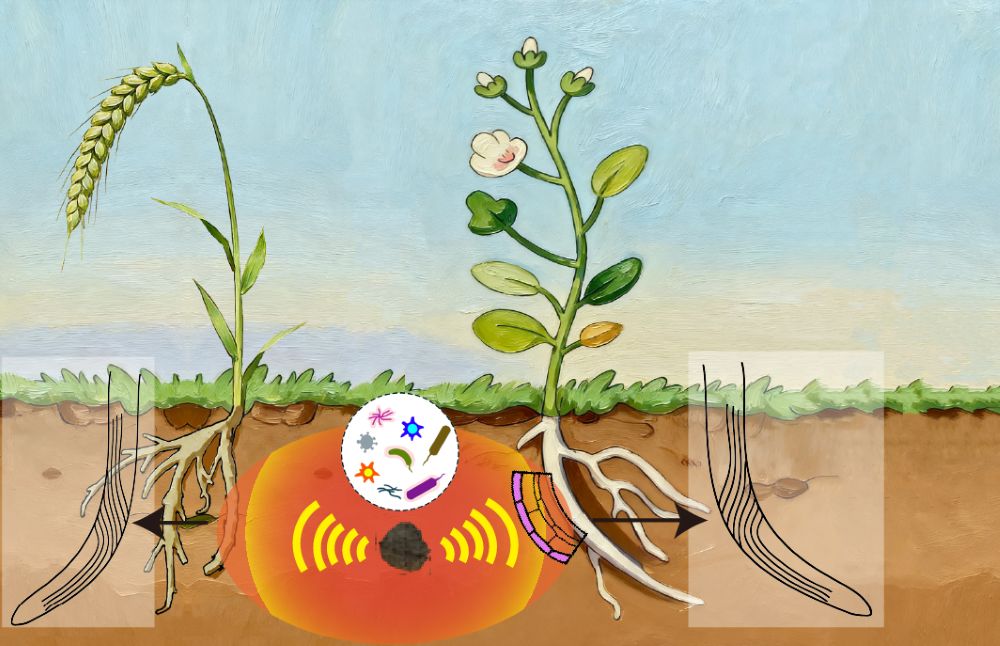
“Going beyond the classic tropisms such as gravitropism, phototropism, and hydrotropism was Yuzhou’s idea,” says co-author Jiří Friml, professor at the Institute of Science and Technology Austria (ISTA). “As an alum of my group at ISTA, he took this question further and identified saprotropism, as well as the mechanisms behind it.”
Saprotropism: Don’t touch dead plants, it’s yucky!
The researchers first showed that direct contact with decaying plant tissue strongly inhibited root growth and activated defense pathways linked to immunity and pathogens. In other words, roots treated these decay zones as biologically threatening environments.
“Animals instinctively avoid rotten food because it often harbors harmful microbes,” says corresponding author Yuzhou Zhang, Professor at Northwest A&F University in China and an alum of the Friml group at ISTA. “We wondered whether plants, although immobile, might have evolved a comparable strategy below ground.”
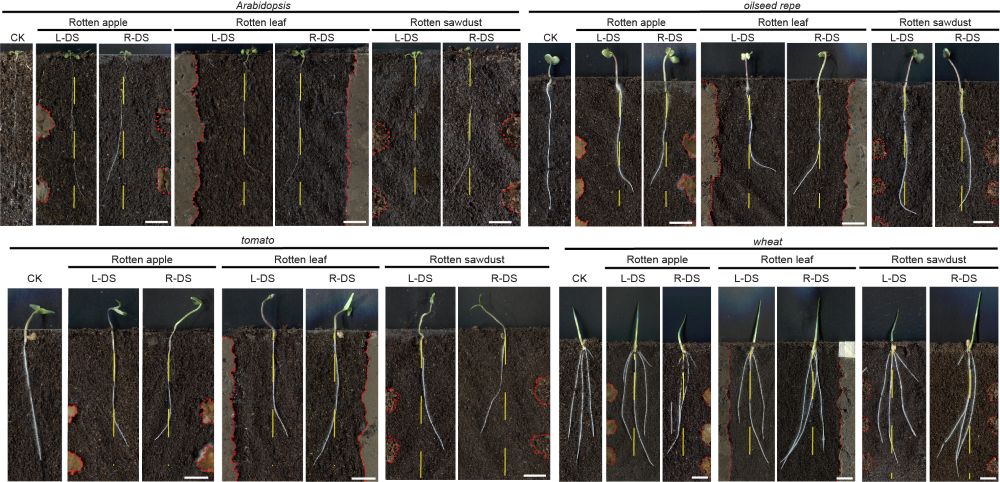
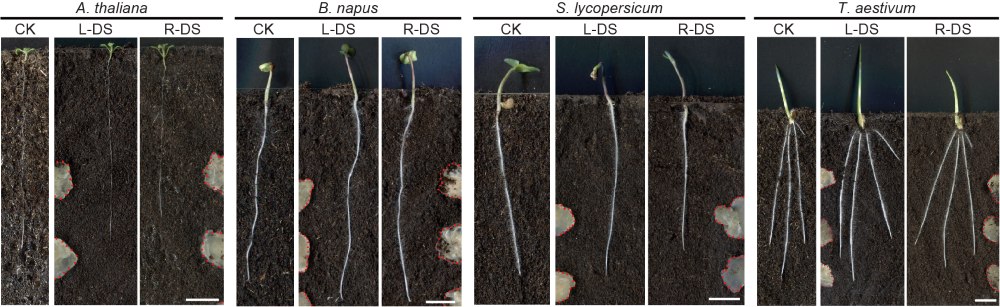
And, in fact, they do: The newly identified tropism enables roots to actively bend away from decaying plant matter. In experiments, roots avoided decay zones made from ‘fleshy’ matter such as apples or leaves, and—contrary to initial assumptions—also from woody material such as sawdust.
Dead animals don’t bother plants
However, when the researchers tested animal-derived decay, such as small pieces of chicken meat, the roots showed no directional growth response.
“One of the striking findings was therefore that the roots did not simply avoid anything rotten,” says Friml. “They responded specifically to decomposing plant material. This tells us that saprotropism is not a general reaction to rot, but a dedicated response to plant-derived decay.”
The response was observed not only in the model plant Arabidopsis thaliana, but also in crop species including rapeseed, tomato, and wheat—suggesting that saprotropism is widespread among plants.
Watching the effects of a tiny ‘plant graveyard’
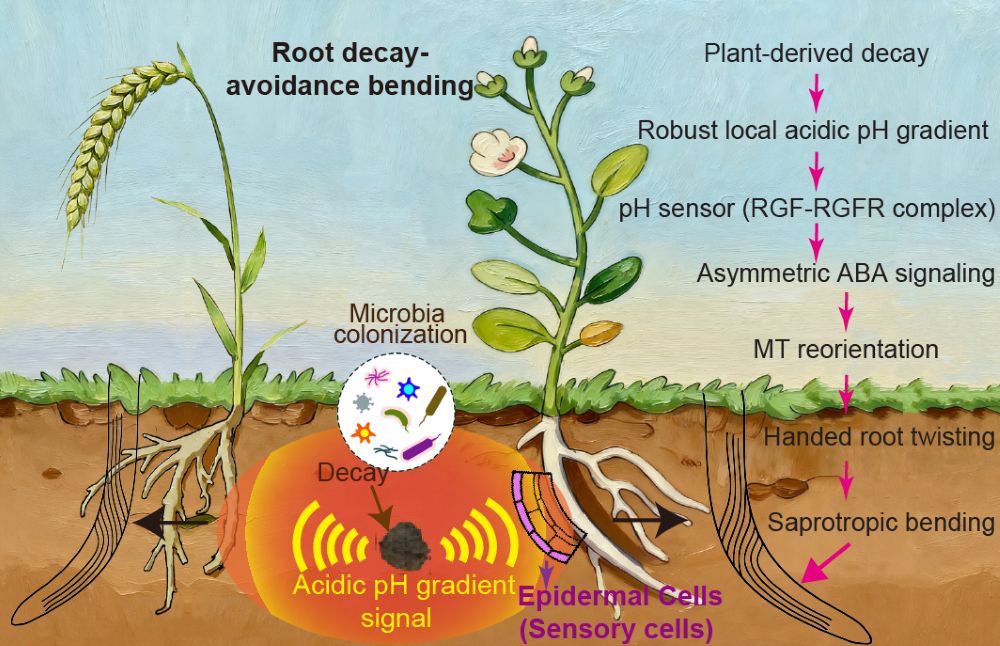
The team found that a key signal comes from microorganisms, especially fungi, as they break down dead plant material. During decomposition, fungi release acidic metabolites, including organic and phenolic acids. These compounds diffuse into the surrounding soil and create stable local pH gradients around the decaying material. Roots can detect this acidity pattern even before direct contact and use it as directional information, bending away from the more acidic side.
However, the ‘plant graveyard’ does not send a permanent warning signal—it stops automatically after the matter has turned into soil. “Once the plant material had almost fully broken down, the acidic warning signal faded—and the roots stopped bending away,” explains Zhang.
To study the process under controlled conditions, the researchers used a vertical split-agar system—a flat, upright plate in which different agar media create a defined chemical gradient. As roots grow downward along the plate, scientists can observe whether they bend toward or away from a specific cue, such as acidity connected with decay.
“At ISTA, we have used similar systems for many years to study how roots grow toward water,” says Friml. A specialized vertical microscope had been constructed at the Institute for that specific purpose. “Now, that same setup helped reveal the opposite response—roots growing away from a potentially harmful cue. Unlike other tropisms, the key player here isn’t the plant hormone auxin.”
Roots dance to the sound of ABA
Within the root, an external signal is transformed into a growth decision: Cells on the root surface detect that one side of the root is exposed to stronger acidity than the other. This uneven signal changes the distribution of the plant hormone abscisic acid, or ABA, across the root tip. As a result, the internal framework of root cells is rearranged, causing one side of the root to grow differently than the other. The root then bends away from the decaying plant material.
“Our research shows that decaying plant matter is not just a passive source of nutrients,” Zhang states. “It creates a chemical landscape that roots can read. Saprotropism shows how plants interpret microbial activity in the soil and make growth decisions accordingly.”
Fundamental science with relevance for agriculture and food security
The discovery of saprotropism—a term coined by the study authors—opens up new research avenues, such as how roots interpret microbial activity in soil. In the long term, a better understanding of such root behaviors could help inform approaches in agriculture, soil management, and crop resilience.
“Crop culture practices that involve excessive incorporation of undecomposed crop residues can create large decay zones that exceed the root’s capacity to navigate around them, potentially increasing exposure to harmful microbes and promoting root diseases,” explains Zhang. Understanding the molecular basis of saprotropism opens new opportunities to develop crops with enhanced ability to detect and avoid pathogen-rich environments. “In the future, breeding or engineering varieties with stronger ‘decay-avoidance’ capacity could complement conventional disease resistance strategies by preventing root-pathogen encounters before infection occurs,” he sums up.
Publication:
Zhulatai Bao, Huihui Wang, Ai Zhang, Ruxi Gao, Wen Gu, Ni Fan, Jiří Friml, and Yuzhou Zhang. 2026. Roots navigate around decay regions by sensing local pH gradients. Science. DOI: 10.1126/science.adw6568
Funding information:
This project was supported by funding from: Qin Chuangyuan High-level Innovation and Entrepreneurship Talent Program QCYRCXM-2022-237, Fundamental Research Funds for the Central Universities K20200168, National Natural Science Foundation of China 32570375, National Natural Science Foundation of China 32400699, European Research Council (ERC, CYNIPS) 101142681, and the Austrian Science Fund (FWF): P 37051-B.