
November 3, 2026
Splitting Light on a Chip
ISTA & Stanford automatic on-chip light separation could enable future microscopes
Light that is only partly coherent is often treated as a nuisance, but it could help power future microscopes as well as applications ranging from astrophysics to satellite communication. Researchers at Stanford University and the Institute of Science and Technology Austria (ISTA) have developed a chip that automatically separates partially coherent light into its constituent beams—effectively ‘recycling’ light. The results were published in Nature Photonics.
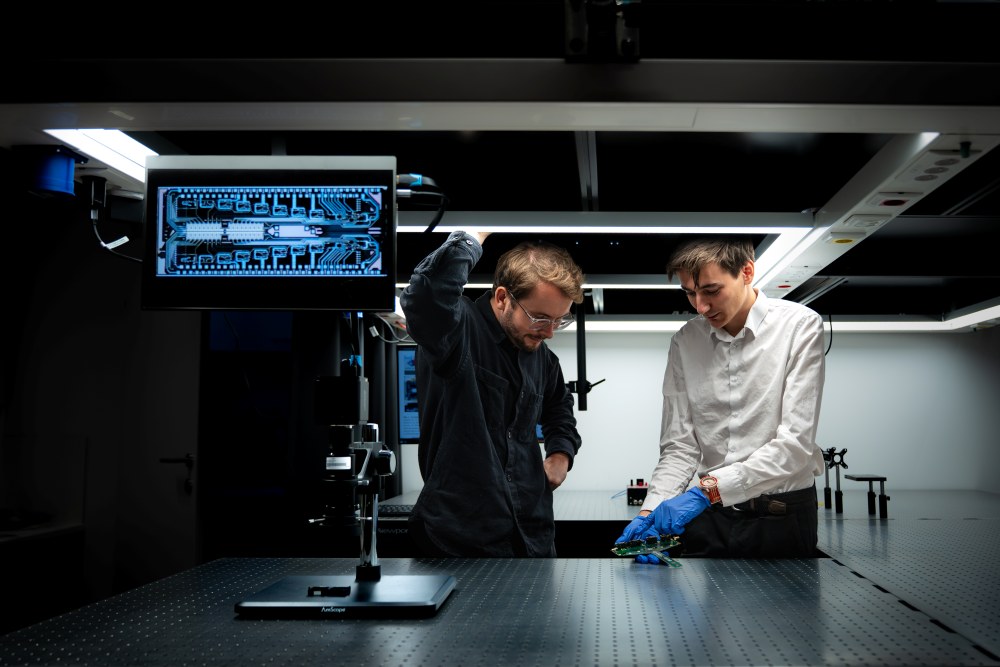
The invention of the laser enabled many technological advances, including computing and optical communication. These technologies rely on laser light with a specific color, with its waves in step—a property called coherence. In contrast, incoherent light consists of a mixture of waves with no consistent phase relationship.
“Unlike laser light, light from most sources is only partially coherent,” says Charles Roques-Carmes, assistant professor at the Institute of Science and Technology Austria (ISTA). “Although it is common, partially coherent light has often been seen as a drawback in technology. However, further advances in optical information processing and microscopy will likely rely on tools that measure and process partial coherence—and perhaps use it as a resource.”
In a new study published in Nature Photonics, Roques-Carmes and colleagues from Stanford University have developed an automatic on-chip system to separate partially coherent light into its constituent modes. The research was conducted mainly at Stanford, where Roques-Carmes began the project with graduate student Paul-Alexis Mor, now a co-first author of the study. Roques-Carmes later established his research group at ISTA, and Mor accompanied him to continue the work there.
The results could lay the groundwork for new microscopy techniques and the chip technology may have broad applications ranging from computation to satellite communication.
A roll of the dice?
Coherence between two beams can be understood through the prism of statistics. “One way to study the behavior of coherent and incoherent light is by examining statistical correlations, like when rolling two dice,” says Mor. If the result of one die affects the result of the other, the outcomes are correlated. In this analogy, correlated light is coherent; uncorrelated light is incoherent. Partially coherent light would show some degree of statistical correlation between these two extremes.
Here, Mor, Roques-Carmes, and their colleagues sought to develop an on-chip system that can precisely measure these correlations. They paid special attention to spatial coherence, which describes how consistently the phase of light is related across different points in a beam. Their approach could find applications in many areas of science and technology. “To develop our technology, we benefited from a boost from the chip industry,” says Roques-Carmes.
When the industry precedes the application
Because partially coherent light has largely been regarded as detrimental, using it as a computational resource remains underexplored.
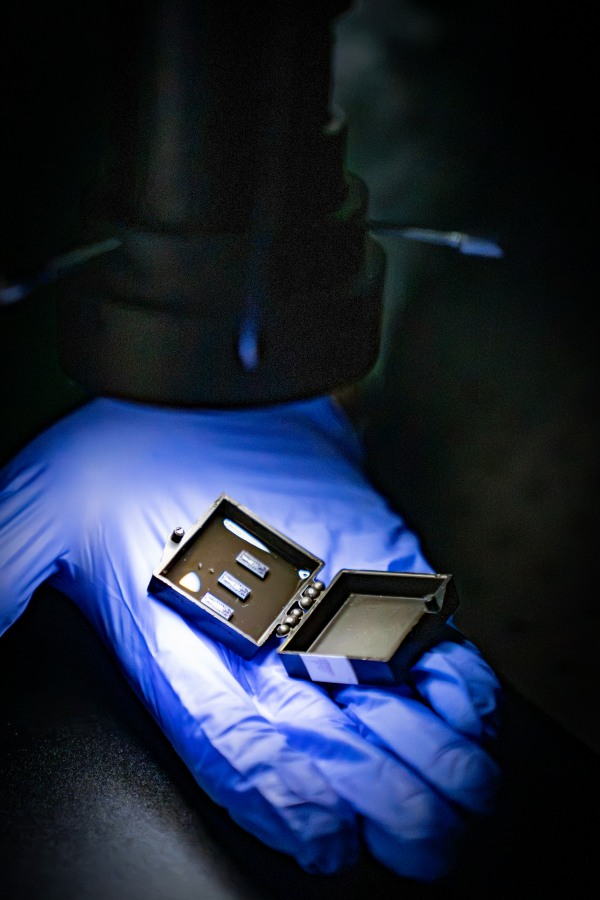
Existing chip-manufacturing capabilities made the team’s new photonic system possible. Chips combine several technologies, including the design, fabrication, and packaging of integrated circuits—microscopic arrangements of electronic and photonic components etched onto semiconductor materials like silicon. In addition, silicon-chip fabrication is already well established.
“This is a rare case in which the hardware industry was ready before the application,” says Roques-Carmes. “Thanks to advances in the photonic chip industry, we can now integrate hundreds of optical components onto a single chip just a few square millimeters in size. Achieving the same functionality with conventional optics would require hundreds of mirrors and other components spread across an optical table. This would be an extraordinarily complex system to align and stabilize, if it were even feasible.”
Recycling light
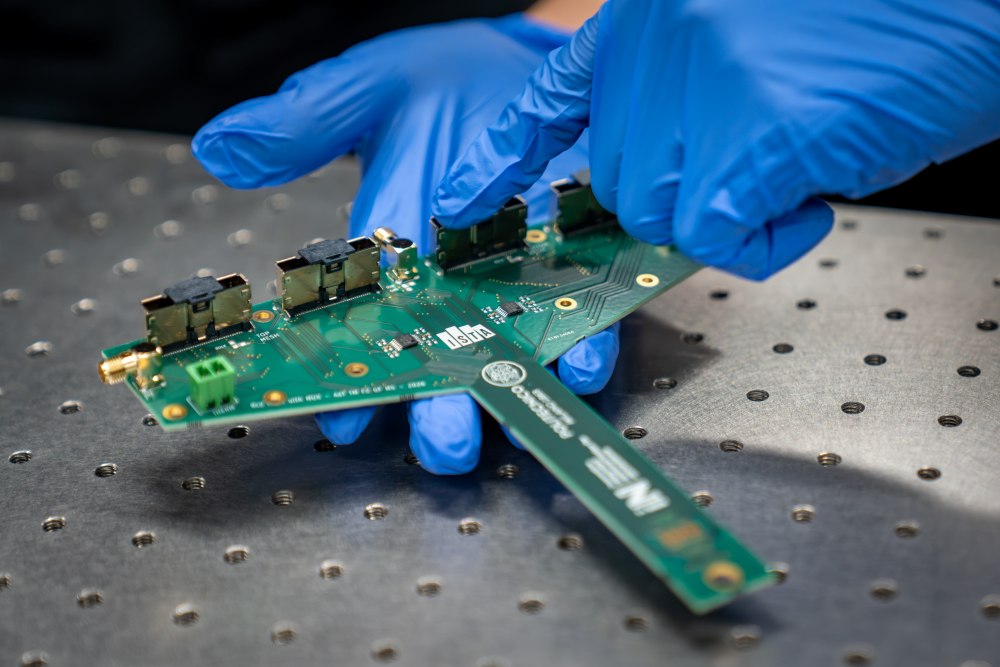
The team designed and fabricated a reconfigurable photonic chip, built the electronics, and mounted the chip on a printed circuit board. They combined this approach with experimental optics and autonomous control algorithms.
The chip’s two-layer self-configuring network architecture incorporates Mach-Zehnder interferometers. These interferometers use passive beam splitters to divide light into two separate physical arms, thus playing a key role in the technology.
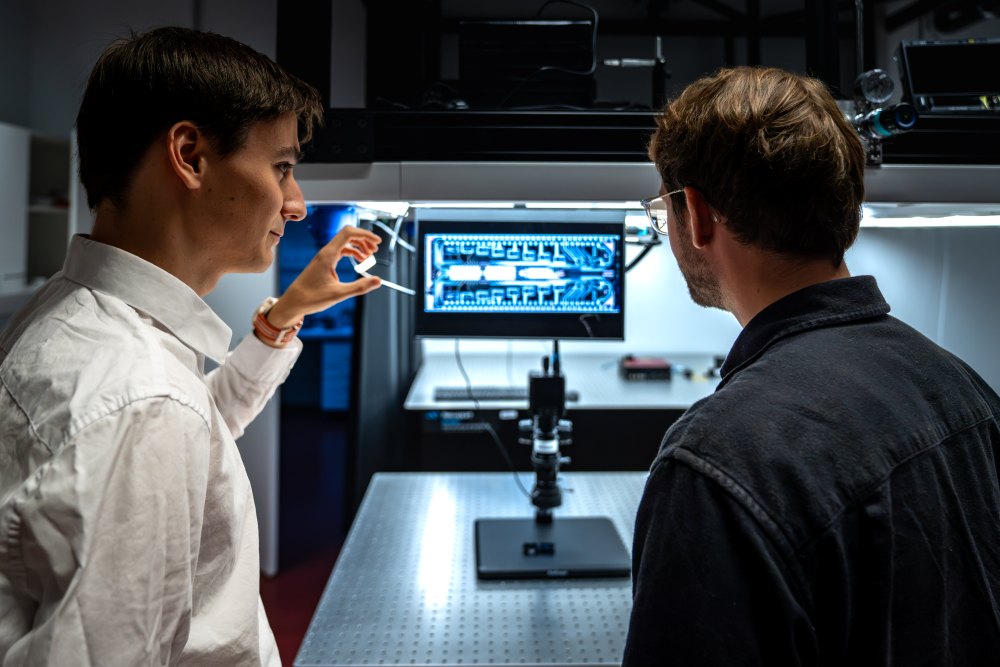
When overlapping ultraviolet beams from two independent lasers enter the chip, they produce partially coherent light, which the chip processes and separates into its component beams. “The chip can ‘see’ the coherence properties of the input light, and it is able to determine automatically that the input consists of multiple beams,” says Roques-Carmes.
Mor adds, “As the light travels through the photonic circuit, the chip separates it into its components in real time, effectively ‘recycling’ the light into physically separate outputs.”
The experiments can even be performed in a normally lit room.
Making every photon count
The researchers’ chip technology could find wide-ranging applications. One possible application is satellite communication, in which laser signals pass through Earth’s atmosphere.
Although laser light is coherent at its source, atmospheric turbulence can reduce its coherence before it reaches a satellite’s detectors. The team’s technology could thus enable satellite detectors to analyze these partially coherent signals.
After Roques-Carmes established his group at ISTA in June, Mor began leading efforts to further develop the technology at the Institute. The team is now exploring applications of this new photonic chip in microscopy and imaging, with a particular focus on the fast processing of weak optical signals.
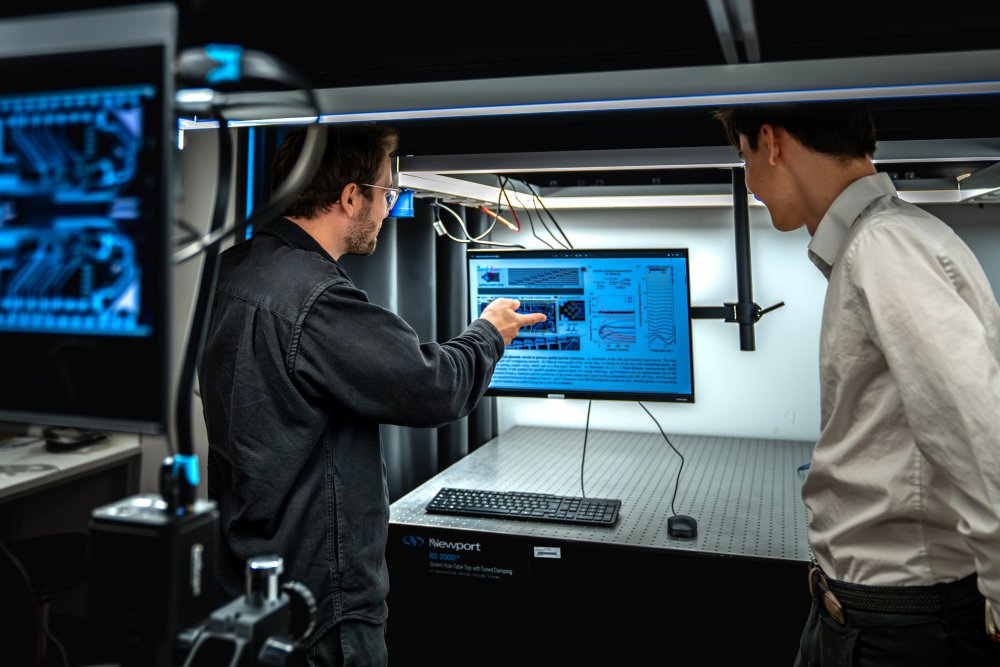
“We are currently taping out a new generation of chips that will be set up and operated at ISTA. We want to make our chips as efficient as possible so that every photon counts,” Roques-Carmes says. “Imagine looking at a very distant object in space. The light such objects emit is typically extremely faint. We want our chips, for instance, to enable astronomers to find answers just by detecting a few photons, such as measuring a star’s diameter or detecting exoplanets around it.”
Mor adds, “We are working toward developing larger, faster chips with additional modes. In addition, we will also work on new applications, such as developing a microscope in close collaboration with ISTA biologists.”
In parallel to his work in the Roques-Carmes group at ISTA, Mor is studying towards an engineering degree at Corps des Mines in France, an esteemed French civil service institution. An additional aspect connecting the two researchers is that Mor and Roques-Carmes both studied at École Polytechnique in France, ten years apart.
“Paul has really carried this project on his shoulders and is now leading this direction in my group as an academic visitor,” Roques-Carmes sums up.
Link to the Stanford University release: https://news.stanford.edu/stories/2026/11/chip-mixed-light-beams-microscopy
Publication:
Paul-Alexis Mor, Anne R. Kroo, Carson G. Valdez, Marko Šimić, Aviv Karnieli, Gabriele Cavicchioli, Zhanghao Sun, Vittorio Grimaldi, Shanhui Fan, Olav Solgaard, David A. B. Miller, and Charles Roques-Carmes. 2026. Automatic on-chip separation of partially coherent light into its mutually incoherent components. Nature Photonics. DOI: 10.1038/s41566-026-02035-6
Funding information:
This project was supported by funding from the Austrian Federal Ministry of Labor and Economy, the Austrian National Foundation for Research, Technology and Development, the Christian Doppler Research Association, the University of Graz, the Air Force Office of Scientific Research (FA955021-1-0312, FA9550-23-1-0307), a Stanford Science Fellowship, and startup funding from the Institute of Science and Technology Austria (ISTA).


